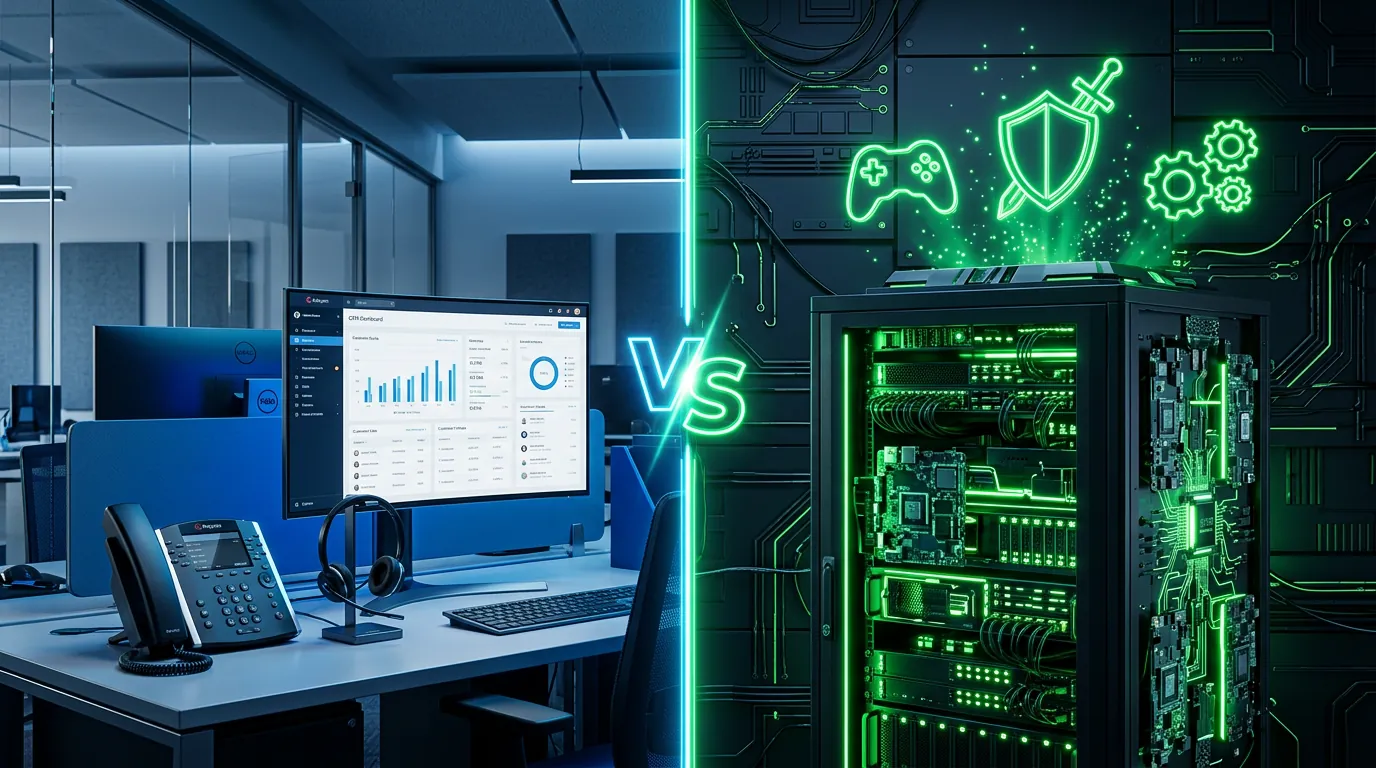
Searching "cloud phone" on Google returns 2 completely different product categories on the same results page — enterprise VoIP systems mixed with Android cloud phones for gaming and multi-account farming. As of 2026 SERPs, the top 5 results split evenly between both industries, causing users to click the wrong product. Cloud PBX is an enterprise IP phone system (Nextiva, RingCentral). Android Cloud Phone is a real ARM device on the cloud for gaming and automation (XCloudPhone, LDCloud).
The article What is Cloud Phone introduced Android Cloud Phone and mentioned the VoIP confusion. This article breaks down the 2 definitions in detail: Cloud PBX and Android Cloud Phone. You will understand why the confusion exists, how each product works, a 10-criteria comparison table, and a framework to pick the right one for your needs.
Why Does "Cloud Phone" Cause Confusion on Google?
"Cloud phone" is a shared term for 2 completely different products — same name, different technology, different audience, and different industry.
When you search "cloud phone" on Google, the SERP mixes 2 categories: pages from Nextiva, Dialpad, and RingCentral promoting VoIP phone systems are interleaved with pages from XCloudPhone, LDCloud, and Redfinger promoting Android cloud phone services. The result: someone looking for AFK gaming clicks a PBX page, and a business shopping for a phone system sees a rack of Android devices.
3 root causes drive this confusion:
- Same marketing term — Both industries self-label as "cloud phone" in titles, meta descriptions, and ad copy. Nextiva calls its product "Cloud Phone System", XCloudPhone calls its service "Real Cloud Phone"
- Both internet-based — Cloud PBX transmits voice over internet (VoIP). Android Cloud Phone streams video over internet (WebRTC). Both are "on the cloud" and both require a network connection
- Both remote access — Cloud PBX lets you make calls remotely via softphone. Android Cloud Phone lets you control a device remotely via browser. Both are "accessible from anywhere"
Google Knowledge Panel currently does not disambiguate the 2 meanings of "cloud phone" — there is no separate disambiguation entry. The algorithm groups them together, confusing both searchers and providers.
Pro Tip: Add a modifier when searching. Want a phone system? Search "cloud phone system" or "cloud PBX". Want an Android cloud phone? Search "android cloud phone" or "cloud phone gaming".
What Is Cloud PBX and VoIP Phone System?
Cloud PBX (Private Branch Exchange) is an IP phone system hosted on the cloud, allowing businesses to manage voice calls, video, and messaging over the internet — without installing physical PBX hardware on-site.
Technical Architecture
Cloud PBX runs on SIP (Session Initiation Protocol): voice signals are encoded into IP data packets, transmitted over the internet to the VoIP provider's server, then routed to the recipient. Endpoints include IP phones (desk phones connected to the network), softphones (desktop applications), and mobile apps.
Major Providers
The Cloud PBX market has 4 major providers holding the largest market share:
Core Features
Cloud PBX provides 5 core features for businesses: IVR (Interactive Voice Response — automated attendant), voicemail-to-email, video conferencing, call recording, and CRM integration. Every feature serves one goal: managing enterprise communications — unrelated to gaming, farming, or automation.
Target users: sales teams, customer support, call centers, and SMBs that need a professional phone system without investing in physical PBX hardware.
What Is Android Cloud Phone?
Android Cloud Phone is a real Android device running inside a data center, letting you access and control it remotely via web browser — built for 24/7 gaming, multi-account social media farming, and Android automation.
Technical Architecture
Android Cloud Phone uses real phone motherboards (ARM mainboards) mounted in server racks. Providers remove the battery and screen, keeping only the ARM processor (e.g., Samsung Exynos 8895, Qualcomm Snapdragon 845). The pipeline: game runs on ARM → screen captured by MediaProjection API → streamed via WebRTC → displayed in your browser. ARM architecture is analyzed in detail in the article What is Cloud Phone.
3 Types of Android Cloud Phone
The Android Cloud Phone market splits into 3 types with different underlying technology:
- VMI (Virtual Mobile Infrastructure) — Runs virtualized Android on x86 servers. Providers: Geelark, Redfinger, UgPhone, and VMOS Cloud. Advantage: scales fast. Disadvantage: no real ARM hardware, GPU uses software rendering
- Android VPS — Virtual server running Android on KVM/Docker. Used for developer testing. Limited gaming performance
- Real Cloud Phone — Physical ARM hardware in data center. Providers: XCloudPhone, LDCloud. Advantage: real Mali GPU, real hardware fingerprint, minimal ban risk
Core Features
Android Cloud Phone provides 5 features built for gaming and automation: anti-detect technology (change IMEI, Android ID in 1 click), proxy integration (HTTP, SOCKS5, WebRTC leak protection), visual automation (no-code drag-and-drop like n8n/Make), multi-instance control (manage 10-100+ devices), and root access (Magisk, Xposed Framework).
Target users: AFK gamers (Ragnarok Origin, MIR4, Night Crows), social media marketers running multi-account farms (TikTok, Facebook, Instagram), MMO agencies, and developers testing on real devices.
Full Comparison: Cloud PBX vs Android Cloud Phone
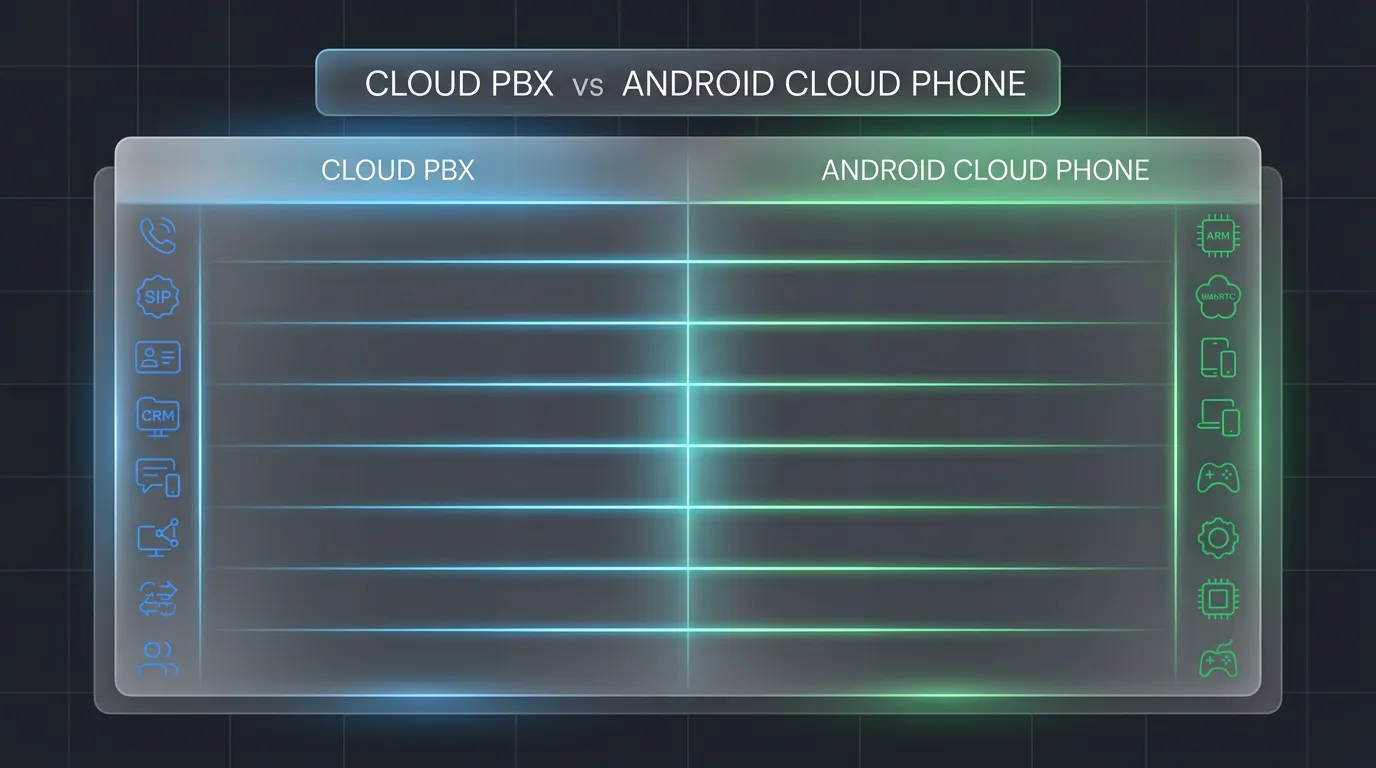
Cloud PBX and Android Cloud Phone differ across all 10 criteria from core technology to target audience — 2 products that do not replace each other, do not compete, and belong to 2 separate industries.
3 Most Important Differences
Difference 1 — Underlying hardware: Cloud PBX runs on standard x86 servers and requires no mobile chip. Android Cloud Phone (Real Device type) requires real ARM phone motherboards mounted in racks — each mainboard runs an independent Android instance with its own IMEI, MAC address, and hardware fingerprint.
Difference 2 — Data transmission protocol: Cloud PBX transmits voice over SIP/RTP — optimized for audio with under 20ms delay. Android Cloud Phone transmits video over WebRTC — optimized for visual content, streaming full HD 60 FPS with under 100ms latency.
Difference 3 — Pricing model: Cloud PBX charges per user (employee using the phone system). Android Cloud Phone charges per device (cloud phone instance rented). Same $100/month: Cloud PBX serves 3-5 employees making calls, Android Cloud Phone provides 10 Android devices running 24/7.
When to Use Cloud PBX? When to Use Android Cloud Phone?
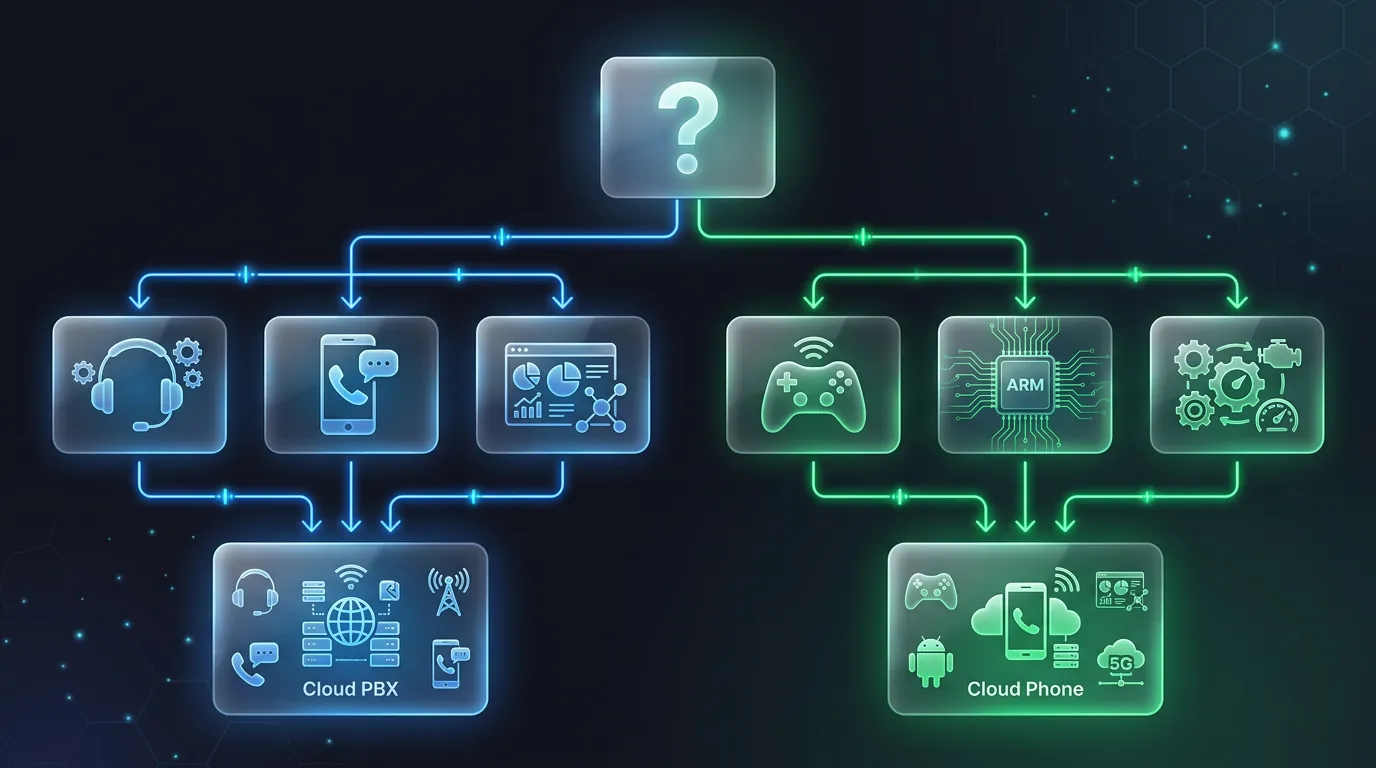
You can pick the right type of cloud phone using 4 self-check questions — each question points to the exact product you need.
Choose Cloud PBX If
You need a phone system for your business: a sales team of 10-50 people calling customers daily, a support team needing IVR routing, or a company needing internal video conferencing. Cloud PBX replaces traditional hardware PBX (Panasonic, Avaya) with a cloud solution — saving hardware costs if your goal is enterprise communications.
Choose Android Cloud Phone If
You need Android devices running 24/7 without buying physical phones: AFK farming resources in Ragnarok Origin, running 50-100 TikTok accounts with each account on a separate device, or farming crypto airdrops across hundreds of independent wallets. Android Cloud Phone replaces physical phone farms with ARM devices on the cloud — saving hardware, electricity, and maintenance costs if your goal is running Android at scale.
Pro Tip: If you need BOTH, you need 2 different providers. Use Nextiva/RingCentral for your phone system + XCloudPhone for gaming/farming. The 2 products do not replace each other.
Frequently Asked Questions (FAQ)
"Is Cloud PBX a Cloud Phone?"
Yes, Cloud PBX is one type of "cloud phone" in the VoIP sense — an enterprise phone system running on the cloud. However, Cloud PBX is completely different from Android Cloud Phone in technology, hardware, and purpose.
"Is XCloudPhone a VoIP Service?"
No, XCloudPhone is an Android Cloud Phone — a real ARM Android device running in a data center for gaming and farming. XCloudPhone does not handle voice calls, has no IVR features, and is not a phone system.
"Are Nextiva and XCloudPhone the Same Type of Product?"
Completely different — 2 products in 2 industries, 2 audiences, and 2 technology platforms. Nextiva provides UCaaS (Unified Communications) for business calling. XCloudPhone provides a Real Cloud Phone for gaming and automation.
"Why Does Google Show VoIP Results When Searching for Cloud Phone Gaming?"
Google mixes the 2 meanings because both industries use the keyword "cloud phone" in SEO. Add a modifier like "android", "gaming", or "AFK" to your search query to filter to the right product category.
"Can You Use Cloud PBX for Gaming?"
No, Cloud PBX only handles voice calls and video — it cannot run Android apps, has no GPU rendering, and does not support gaming. Choose an Android Cloud Phone (XCloudPhone, LDCloud) if you need cloud gaming.
2 Products, 2 Needs — Do Not Let the Name Fool You
Cloud PBX and Android Cloud Phone share the name "cloud phone" but serve 2 entirely separate needs: enterprise communications and Android device operations. Choosing the wrong type means buying a product that lacks the features you need.
Need an Android Cloud Phone for AFK gaming, multi-account farming, or automation? XCloudPhone provides real ARM devices at around $10/device — minimal ban risk thanks to real hardware, built-in proxy with WebRTC leak protection, and no-code visual automation. Get started at app.xcloudphone.com.