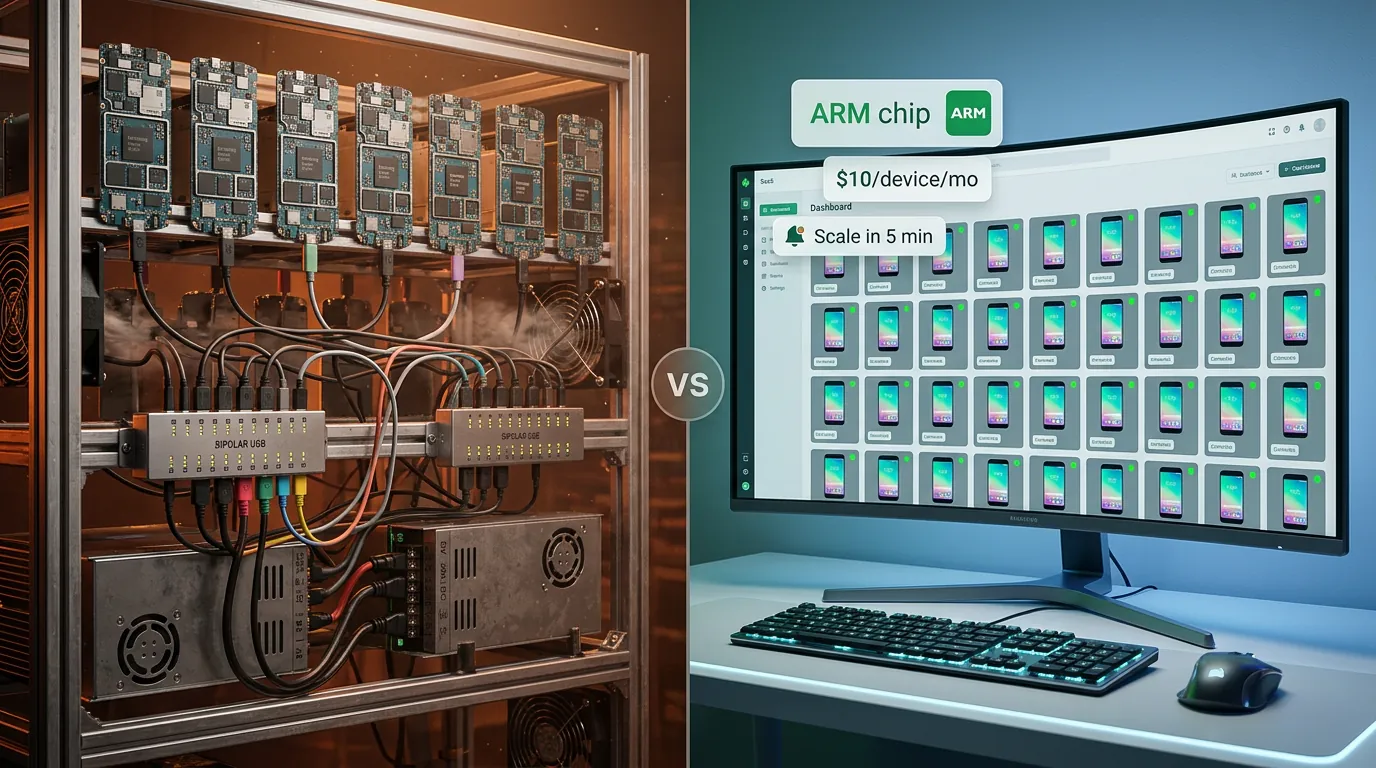
Agencies running phone farms face the same question: rent a cloud phone service (~$10/device/month) or buy stripped Samsung mainboards, assemble racks, and build an in-house farm? The answer depends on scale, technical team, and commitment timeline — but most agencies miscalculate TCO by overlooking 5 hidden costs.
In the full cloud phone vs emulator comparison, real ARM architecture — the same architecture you use when self-building — was identified as the determining factor for fingerprint quality and ban rates. This article focuses on the financial angle: when is self-building actually cheaper than renting?
Self-building is only cheaper than renting when 3 conditions are met simultaneously: over 200 devices, a full-time technical team, and commitment exceeding 18 months.
This article covers what you need to self-build, 12-month TCO at 4 scales (10–500 devices), break-even analysis, 5 hidden costs agencies overlook, and a decision matrix for choosing the right model.
What Do You Need to Build a Phone Farm?
Building a phone farm requires 4 categories: hardware, rack + cooling, network, and software. The basic process: purchase used phones → strip battery + screen → mount mainboard on rack → supply DC power → connect OTG/LAN → install control software.
The most commonly used phones are Samsung S8, Note 9, and Note 20 — models with durable mainboards, low secondhand prices, and ARM chipsets strong enough for farming. GenFarmer (one of the largest phone farm kit providers) sells 20-device kits from $400 (basic) to $1,400 (premium).
12-Month TCO at 4 Scales: 10, 50, 100, 500 Devices
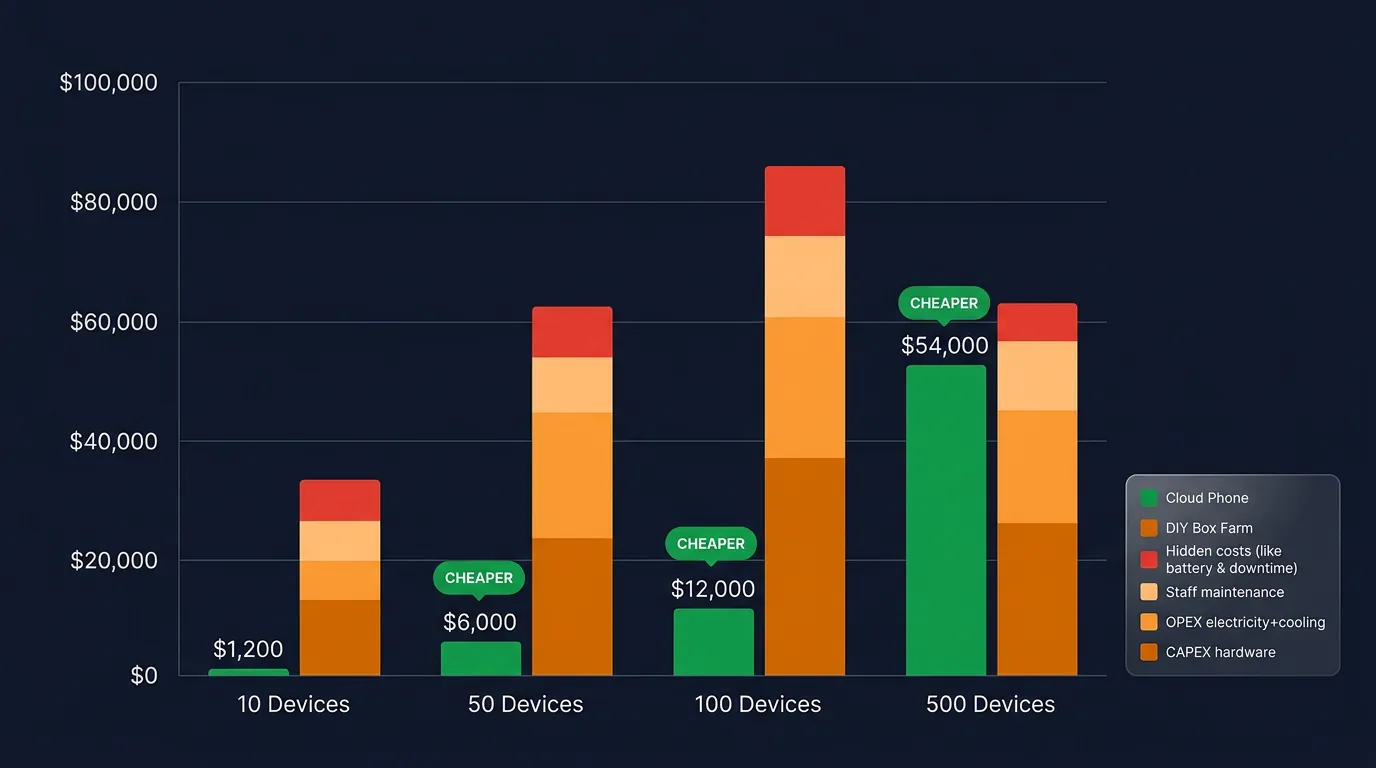
12-month TCO shows cloud phone costs less than self-building at every scale under 200 devices — and only breaks even at very large scales with a dedicated technical team. Self-building is only cheaper than renting when scaling past 200 devices AND having a full-time technical team.
10 Devices — Individual/Hobby
- DIY: CAPEX $200-600 (mainboard + small rack) + OPEX ~$50-80/month (electricity, internet) → 12 months = $800-1,560
- Cloud Phone: $0 CAPEX + $100/month ($10/device) → 12 months = $1,200
- Verdict: DIY appears cheaper on paper ($800 vs $1,200), but factoring in setup time (8-16 hours), troubleshooting (2-4 hours/month), and battery replacement (every 3-6 months) → renting is more convenient, total cost equivalent
50 Devices — Small Agency
- DIY: CAPEX $1,000-3,000 + OPEX $250-450/month (electricity, cooling, internet) + part-time staff $300/month → 12 months = $7,600-12,000
- Cloud Phone: $0 CAPEX + $500/month ($10/device) → 12 months = $6,000
- Verdict: DIY does NOT break even within 12 months. Cloud phone is 21-50% cheaper
100 Devices — Professional Agency
- DIY: CAPEX $5,000-15,000 + OPEX $800-1,500/month + staff $800/month → 12 months = $24,200-45,000
- Cloud Phone: $0 CAPEX + $1,000/month ($10/device) → 12 months = $12,000
- Verdict: Cloud phone is 50-73% cheaper. Difference of $12,000-33,000 — enough to invest in account farming instead of hardware
500 Devices — Enterprise Farm
- DIY: CAPEX $10,000-30,000 + OPEX $3,000-5,000/month + full-time staff $1,500/month → 12 months = $64,000-108,000
- Real ARM Cloud: $0 CAPEX + $4,500/month (volume discount $9/device) → 12 months = $54,000
- VMI Cloud (budget): $0 CAPEX + $2,000/month ($4/device) → 12 months = $24,000 — but 15-25% ban rate erodes revenue
- Verdict: DIY begins approaching cloud at this scale. Break-even occurs at month 16-24 IF you have a full-time technical team
Break-Even — When Is Self-Building Actually Cheaper?
Self-building is only cheaper when 3 conditions are met simultaneously — conditions that are difficult to satisfy. 3 break-even conditions: over 200 devices, full-time technical team, and commitment exceeding 18 months.
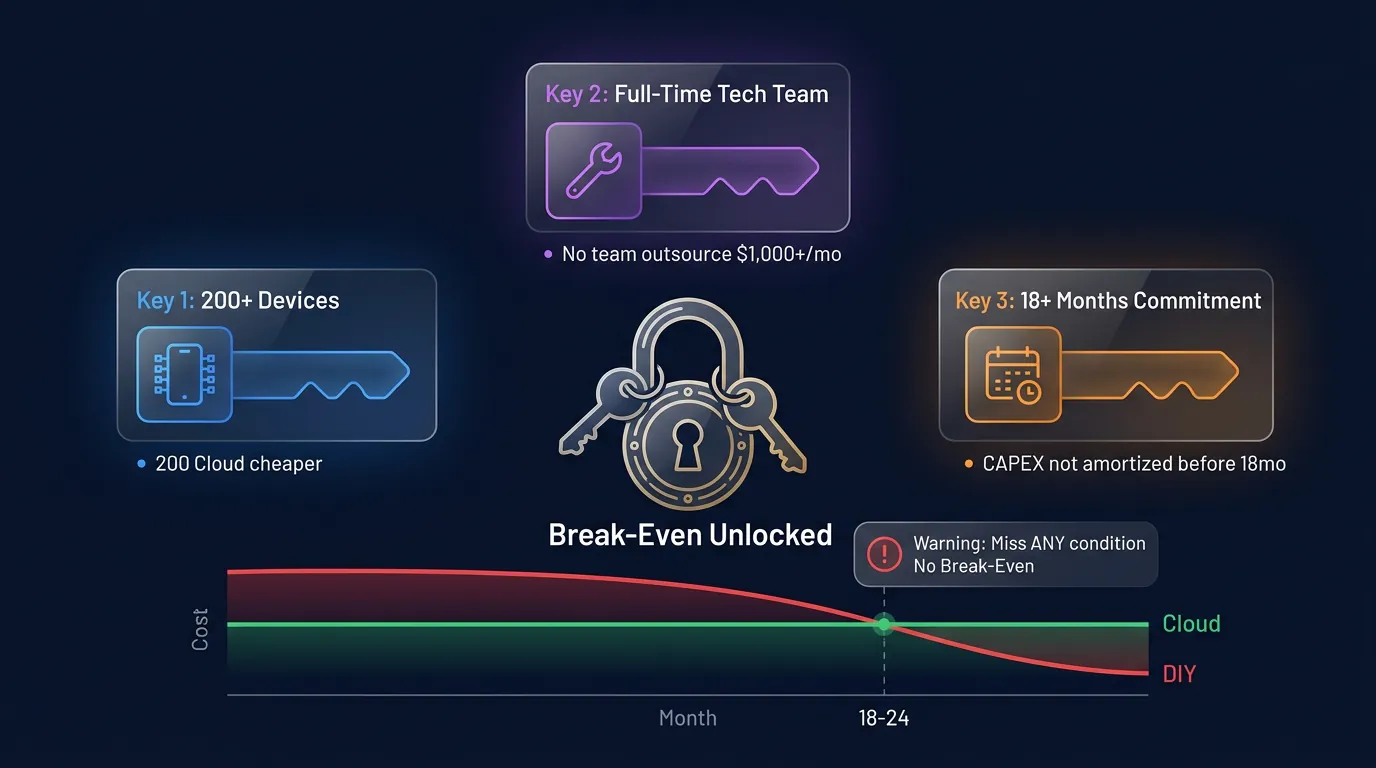
- Scale over 200 devices: Per-device OPEX drops as fixed costs (rack, power, business internet) are distributed. Below 200 devices, DIY per-device OPEX exceeds cloud subscription cost
- Full-time technical team: Without a team → must outsource maintenance → adds $1,000+/month, breaking the break-even point. Team needs skills: flash firmware, troubleshoot USB hubs, replace mainboards, manage network
- Commitment exceeding 18 months: $10,000-30,000 CAPEX isn't amortized before 18 months. If you stop early → total CAPEX loss, secondhand devices lose 60-70% of value
For a 200-device fleet, DIY vs Cloud ARM break-even occurs after approximately 18 months without hidden costs. Factor in hidden costs (next section) → break-even extends an additional 6-12 months, reaching 24-30 months total.
The box phone farm vs cloud phone farm analysis compares CAPEX/OPEX/TCO in detail for 3 scales: 50/200/1,000 devices — including hidden costs and how ban rates affect actual revenue.
5 Hidden Costs of Self-Building That Agencies Overlook
5 hidden costs increase DIY TCO by 30-50% over initial estimates — and most agencies only realize this after 3-6 months of operation.
A Reddit user shared: "Woke up to 3 puffy batteries at 2AM. Had to disconnect power and air out the room." — battery swelling isn't just a financial cost but a genuine safety hazard. The University of Reading has published research on fire safety protocols for lithium-ion battery racks — a must-consider risk for anyone operating a phone farm at home.
Decision Matrix — When to Build, When to Rent?
Most agencies should rent cloud phones — only a very small percentage meet the conditions for profitable self-building.
The Phone Farm as a Service article details scaling roadmaps from 10 to 1,000 devices — most successful agencies start with cloud and only transition to hybrid beyond 500 devices. The comprehensive cloud phone vs emulator comparison analyzes the pros and cons of real ARM architecture for both rent and build models.
XCloudPhone provides real ARM hardware, ~$10/device/month, $0 CAPEX, scale within 5 minutes. Sign up at app.xcloudphone.com.
FAQ
"How Much Capital Do You Need to Build a Phone Farm?"
$200-$30,000 depending on scale from 10 to 500 devices. GenFarmer 20-device kits start at $400 (basic, mainboard + rack only). Premium kits (including cooling, hub, software) from $1,400. Enterprise-scale 100 devices: $5,000-$15,000 CAPEX.
"Is There a Device Limit for Cloud Phones?"
No. Cloud phones scale on demand, from 1 to 1,000+ devices. Add new devices in 5 minutes, no hardware purchase, no setup required. Volume discounts apply from 50 devices.
"Is Battery Swelling a Real Safety Hazard?"
Yes. Lithium-ion overcharge + sustained high temperatures → thermal runaway → fire and explosion risk. The University of Reading recommends fire safety protocols for lithium-ion racks. Cloud phones eliminate this risk entirely — batteries are removed, DC power supplied directly.
"Is a Hybrid Model (DIY + Cloud) Effective?"
Yes, for transitional phases. High-value accounts run on physical devices (maximum fingerprint consistency), remaining accounts on cloud phones. Most agencies start 100% cloud → transition to hybrid when scaling past 300-500 devices.
Rent or Build: Decide Based on Data, Not Intuition
12-month TCO shows cloud phones are cheaper than self-building in 3 of 4 common scale brackets. Only at enterprise scale (over 200 devices) with a full-time technical team does self-building begin to break even — and only after 18-24 months. Don't decide based on upfront CAPEX alone — the 5 hidden costs add 30-50% to actual TCO.