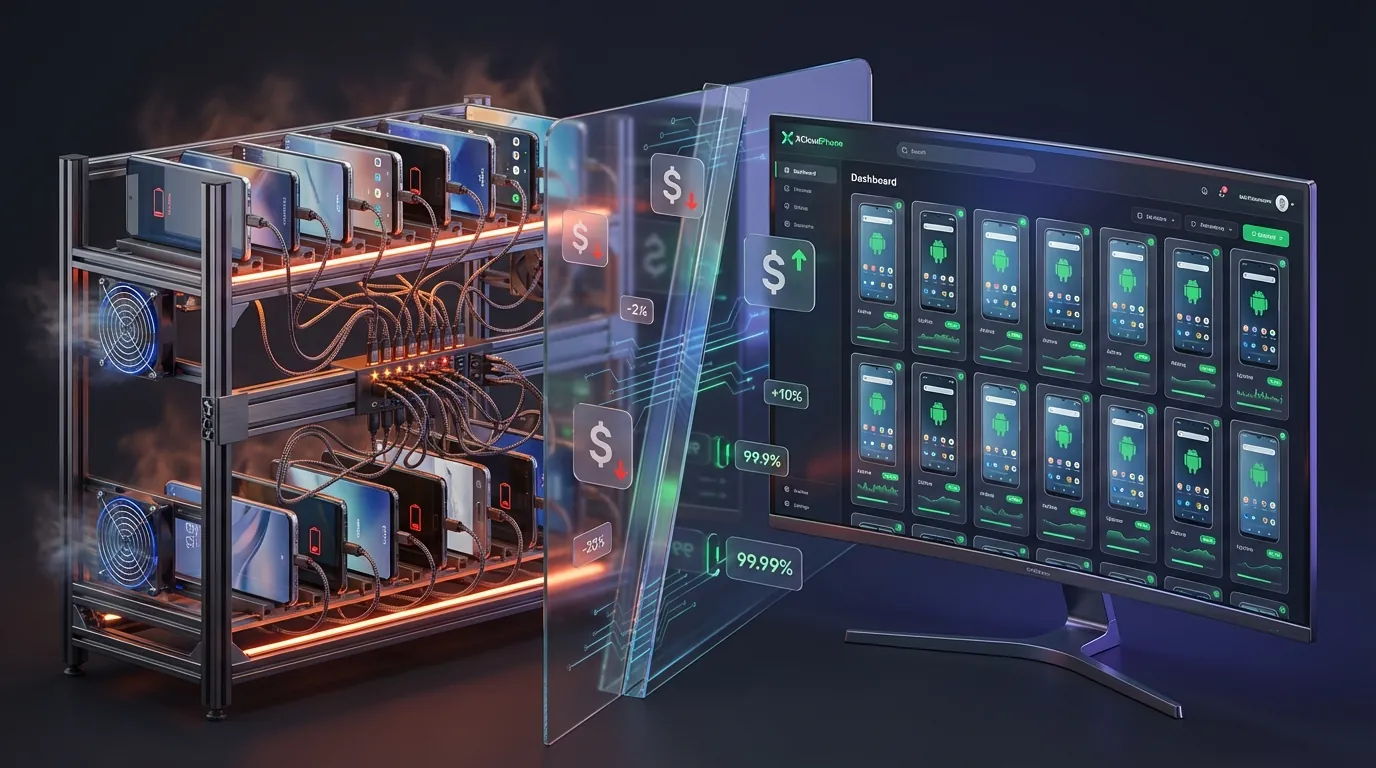
CAPEX for 100 box phone farm devices ranges from $10,000 to $30,000 — while a cloud phone farm starts at $0 in hardware investment. The 12-month TCO gap between the two models at 200 devices reaches 12–22%, and this figure excludes hidden costs that most agencies overlook during planning.
In the Cloud Phone vs Emulator comparison, the architectural differences between ARM and x86 were analyzed in detail. This article goes deeper into the financial and operational side — helping agencies make investment decisions based on data rather than estimates.
This guide covers:
- CAPEX and OPEX — upfront investment vs monthly operating costs
- Hidden costs — battery swelling, fire hazards, downtime, and insurance
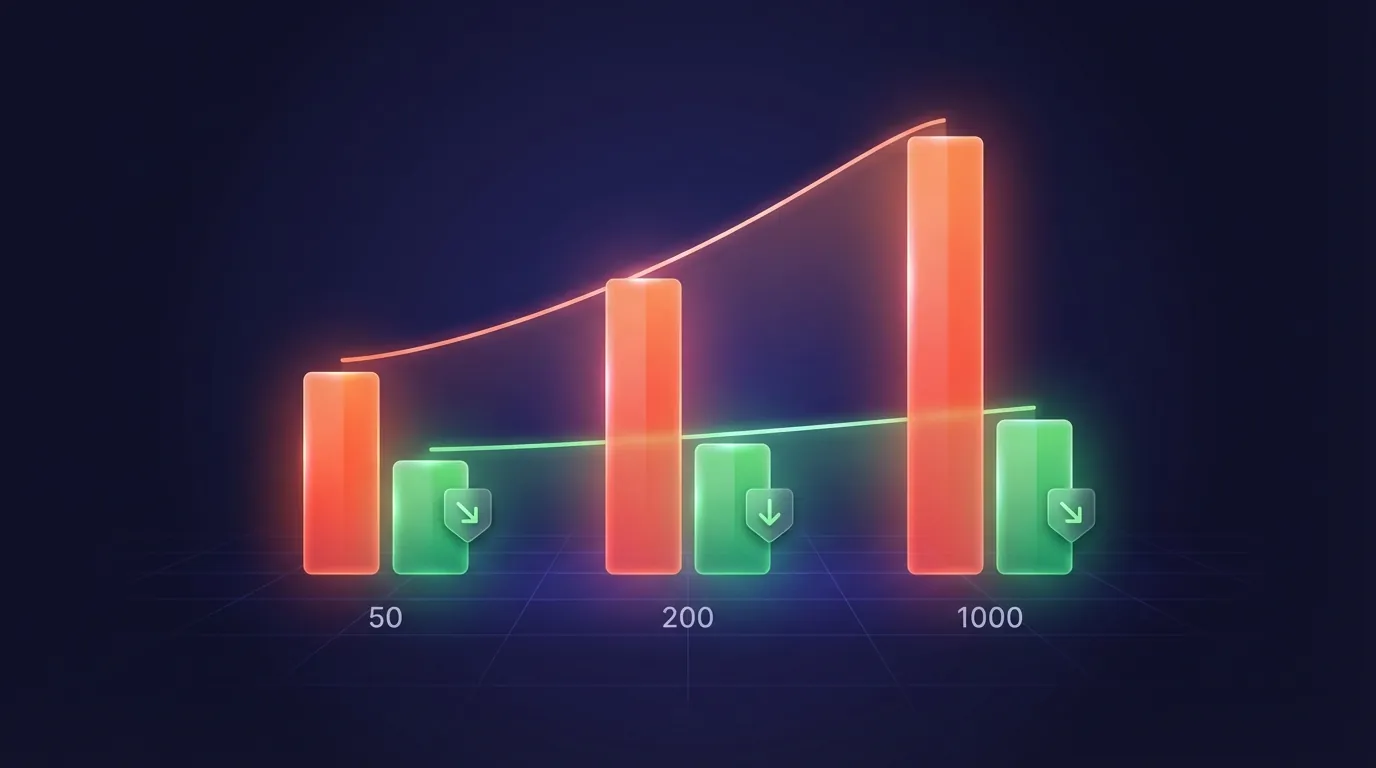
- 12-month TCO — total cost of ownership for 50, 200, and 1,000 devices
- Break-even and scalability — time to ROI for each model
- Decision matrix — recommendations by use case, budget, and scale
How Do Box Phone Farms and Cloud Phone Farms Differ?
Box phone farms and cloud phone farms serve the same purpose — running multiple Android devices simultaneously for AFK gaming, social media account management, or marketing automation — but rely on two fundamentally different infrastructures.
Box Phone Farm — Physical Hardware Infrastructure
A box phone farm uses physical Android devices (Samsung J7, Redmi Note 7, Oppo A3s) mounted on racks, connected via USB hubs, and managed through centralized control software. Investment costs depend on device quantity, secondhand device pricing, and supporting infrastructure (racks, cooling fans, cables, and power strips).
This model requires: physical space (1m² for 20–30 devices), stable power supply, and dedicated staff — replacing batteries, rebooting frozen devices, and handling hardware failures.
Cloud Phone Farm — Remote Devices on Cloud Infrastructure
A cloud phone farm uses Android devices hosted in data centers, accessed remotely via the internet. Each cloud phone is a separate instance with unique IMEI, MAC address, and Android ID — agencies control everything through a web dashboard or API.
CAPEX is $0 because all hardware is managed by the provider. The only cost is a monthly subscription ($6–15/device/month depending on provider and plan).
VMI Cloud Phone vs Real ARM Cloud Phone — Two Different Types of Cloud
Not all cloud phones are the same. The market has 2 main types:
Upfront Investment (CAPEX) — Which Model Requires More Capital?
Box Phone Farm CAPEX — Hardware, Racks, and Accessories
Box phone farm CAPEX includes 4 main categories:
- Devices: Secondhand phones range from $15–70 each (Samsung J7 ~$15, Redmi Note 8 ~$40, Samsung A52 ~$70). For 100 devices: $1,500–$7,000
- USB hubs and cables: 20-port hubs ($50–80/hub) × 5 sets + USB cables ($2/cable) × 100 = $350–$600
- Racks and cooling: Metal shelving ($50–150), industrial fans ($30–50/fan) × 4 = $170–$350
- Control software: Scrcpy (free) or Aerophone ($200–500/year) = $0–$500
GenFarmer — a box farm solution provider — sells 20-device kits priced from $308 (basic) to $1,408 (premium). Total CAPEX for 100 devices ranges from $1,540–$8,450, not including space and power infrastructure costs.
Cloud Phone Farm CAPEX — $0 Hardware, Subscription Only
Cloud phone farm CAPEX is $0 — no devices, racks, cables, or control software to purchase. All infrastructure is managed by the provider.
The only cost to get started: create an account (usually free) and subscribe for the number of devices needed. With XCloudPhone, a starter pack of 10 devices costs ~$100/month, with no long-term commitment.
Monthly Operating Costs (OPEX) — The Real Numbers Few Discuss
Box Phone Farm OPEX — Power, Maintenance, Battery Replacement, and Staff
Box phone farm operating costs include 5 categories (typically underestimated by 30–50%):
- Electricity: Each phone charging 24/7 draws ~3W. 200 phones = 600W × 24h × 30 days = 432 kWh/month. At $0.12/kWh (Southeast Asia): ~$52/month. At $0.17/kWh (US): ~$73/month
- Internet: Bandwidth for 200 devices streaming/uploading = business-grade plan ~$50–100/month
- Battery replacement: 10–15% of devices need new batteries monthly (swelling, degradation). 200 × 12% × $5/battery = ~$120/month
- Device replacement: 3–5% of devices fail monthly. 200 × 4% × $30 = ~$240/month
- Staff oversight: At least 1 part-time ($200–500/month) or full-time ($800–1,500/month) technician
Cloud Phone Farm OPEX — Subscription, Proxy, and Automation Tools
Cloud phone farm OPEX is straightforward:
- Subscription: $8–12/device/month (Real ARM) or $3–5/device/month (VMI)
- Proxy: $2–5/device/month (residential proxies for social media farming)
- Automation tools: $50–200/month (varies by scale; many cloud phones include built-in automation)
Detailed Monthly OPEX Comparison
Hidden Costs of Box Phone Farms — Batteries, Fire Hazards, and Downtime
Battery Swelling and Fire Risk — An Operator’s Nightmare
The single largest hidden cost of a box phone farm involves lithium-ion batteries. Under continuous 24/7 charging, batteries begin to swell after 4–8 months. With a 200-device setup, 20–30 units need inspection and 10–15 need immediate battery replacement each month. A phone farm operator on r/phonefarm described: “Woke up to 3 puffy batteries at 2AM, had to disconnect everything and air out the room.”
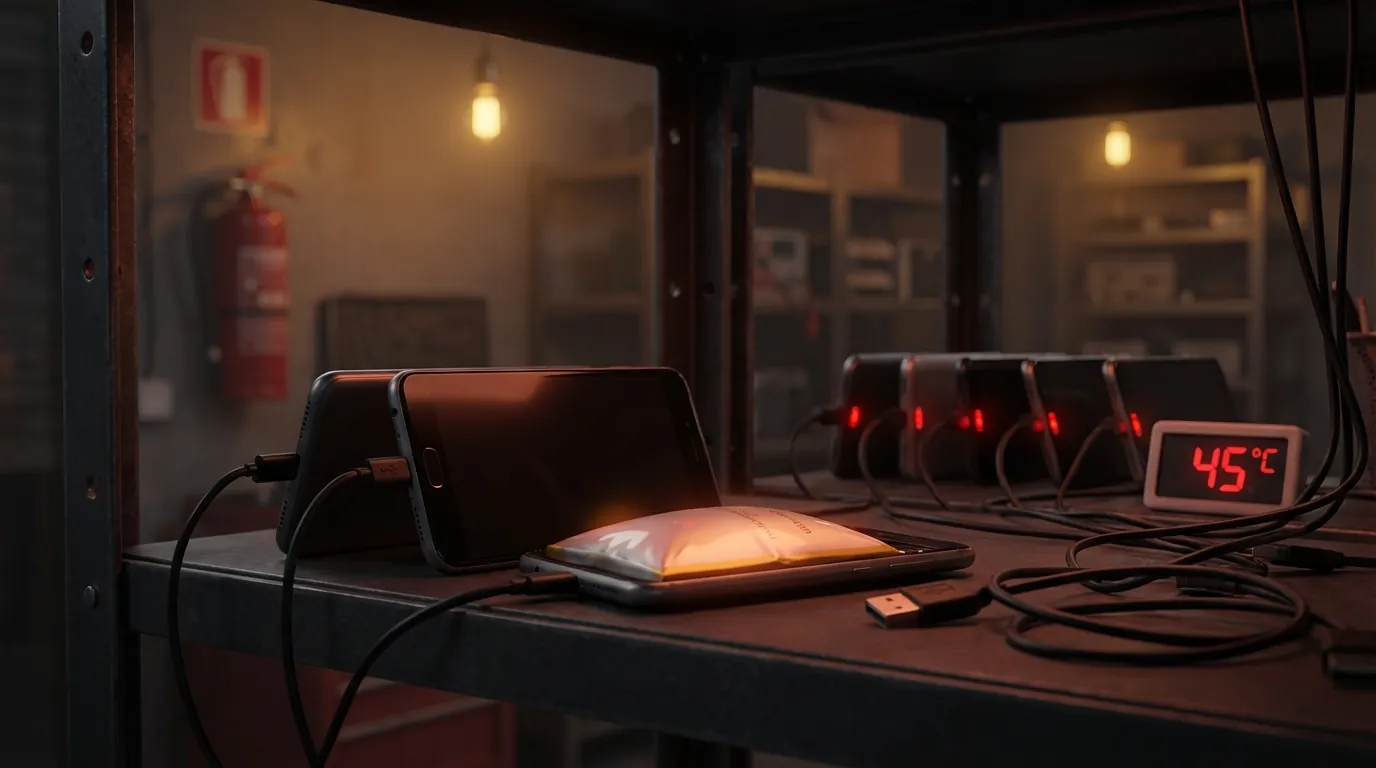
Fire hazard is a real concern — some jurisdictions require separate fire insurance for continuously operating electronic equipment. Insurance cost: $500–2,000/year depending on scale.
Downtime and Dead Devices — Lost Revenue
Every dead device means a lost farming account plus setup time for a replacement. Average device failure rate: 3–5%/month. With 200 devices, you lose 6–10 units monthly — equivalent to $180–$700 in replacement costs plus 4–8 hours of setup per device.
Space and Cooling — Costs Not Everyone Accounts For
200 devices require roughly 7–10m² (75–108 ft²) of dedicated space with proper ventilation. Room temperature must stay below 30°C (86°F) — additional cooling costs $30–80/month depending on your region's climate.
Cloud phone farms eliminate all 3 risks: no batteries (ARM motherboards have batteries removed), no hardware downtime (data centers offer 99.9% SLA), and no physical space needed.
12-Month TCO — Total Cost of Ownership at 3 Scale Levels
TCO (Total Cost of Ownership) over 12 months includes CAPEX + OPEX × 12 + hidden costs — this is the number agencies should compare, not listed prices on websites.
The Cloud Mobile Infrastructure market is projected to reach $3.3 billion by 2031, according to Allied Market Research — reflecting the accelerating shift from physical infrastructure to cloud.
📌 Pro Tip: The TCO gap widens as scale increases — because box farm hidden costs grow exponentially (more device failures, more battery replacements, more staff needed), while cloud farm costs scale linearly (subscription only).
Break-Even and Scalability — Faster ROI When Expanding
Box Phone Farm Break-Even — 6 to 12 Months
Box phone farms need 6–12 months to recoup CAPEX, depending on revenue per device. At an average income of $3–5/device/month from farming, break-even time for 100 devices ($5,000 CAPEX): 5,000 ÷ ($4 × 100) = 12.5 months — assuming 0% device failure (rarely achievable in practice).
Cloud Phone Farm Break-Even — 1 to 3 Months
Cloud phone farms break even faster because CAPEX = $0 — first-month revenue is already profit (minus OPEX). At the same $4/device/month revenue with $11/device/month Real ARM OPEX: break-even occurs when revenue ≥ OPEX. Agencies need each device generating at least $11/month to be profitable.
Scale Factor — Why Cloud Farms Have Better Break-Even at Scale
Ban Rate and Fingerprint Quality — The Factor That Really Affects ROI
Ban rate determines actual ROI — because every banned account means all farming time invested in that account is lost.
Box Phone Farm — Good Fingerprint But Limited Scale
Box phone farms use real physical devices — genuine fingerprints, low ban rate (3–8% on Facebook, TikTok). However, running multiple accounts on the same device or within the same IP range pushes ban rates up to 10–15%.
VMI Cloud — Cheap But 15–25% Ban Rate
VMI (Virtual Machine Infrastructure) services simulate Android on x86 servers — cheaper than Real ARM but virtualized fingerprints are easily detected by anti-fraud systems. Average ban rate runs 15–25% on platforms with strict anti-bot measures.
Real ARM Cloud Phone — Balancing Fingerprint and Scalability
XCloudPhone runs on real ARM motherboards (batteries and screens removed) — each instance has genuine IMEI, sensor data, and CTS certification. This undetectable cloud phone architecture passed an internal benchmark: 200 devices running continuously for 30 days on Facebook and TikTok — ban rate stayed under 2%. Under identical conditions, a 200-device VMI setup had 18% of accounts restricted.
Ban rates across emulators vs cloud phones were analyzed in detail in the Cloud Phone vs Emulator comparison — with data from 200 devices over 30 days. Combining antidetect browsers with cloud phones provides an additional layer of fingerprint security for high-value campaigns.
Investment Decision — Which Model Fits Your Business Goals?
There is no single "best" model for every situation — the right choice depends on 4 factors: use case, budget, target scale, and ban risk tolerance.
Migrating From Box Phone Farm to Cloud — A 4-Step Process for Agencies
Step 1: Audit Your Physical Farm
Inventory: count active devices, failed/replacement-needed devices, actual monthly OPEX, and current ban rates. Document every number — this becomes your baseline for post-migration comparison.
Step 2: Pilot Test on Cloud (20 Devices, 2 Weeks)
Run 20 cloud phones in parallel with your physical farm — compare ban rate, uptime, and productivity. Sign up at app.xcloudphone.com to start your pilot test.
Step 3: Migration Workflow and Data Transfer
Gradually move accounts from physical to cloud. Avoid migrating everything at once — transfer in batches of 20–50 devices/week to monitor results.
Step 4: Decommission the Physical Farm
Once 100% of your workflow runs on cloud: sell old devices (recover 30–40% of value), cancel business-grade power/internet contracts, and free up your physical space.
Frequently Asked Questions
"What Does a 100-Device Box Phone Farm CAPEX Look Like?"
CAPEX for 100 box phone farm devices ranges from $1,540–$8,450, including secondhand devices ($15–70 each), USB hubs, racks, cooling fans, and control software. GenFarmer sells 20-device kits from $308 (basic) to $1,408 (premium).
"Do Cloud Phone Farms Experience Downtime?"
Cloud phone farms on professional data centers offer 99.9% uptime SLA — equivalent to under 8.7 hours downtime/year. Box phone farms typically experience higher downtime from devices freezing, swelling batteries, or power outages without UPS.
"Is a Hybrid Model (Physical + Cloud) Effective?"
Combining physical and cloud works during the transition phase: run high-value accounts on physical devices, everything else on cloud. Long-term, however, managing two parallel systems costs more than going all-cloud.
"How Many Devices Should a New Agency Start With?"
New agencies should start with 10–20 cloud phones (Real ARM) to test workflows over 2–4 weeks. Trial cost: ~$100–200/month — significantly lower than investing $1,500+ in a physical farm without knowing whether it will work.
"What's the Electricity Cost for 200 Physical Phones Per Month?"
200 phones charging 24/7 consume 432 kWh/month (3W/phone × 24h × 30 days). At Southeast Asian electricity rates ($0.12/kWh): **$52/month**. At US rates ($0.17/kWh): ~$73/month. These figures exclude cooling costs for the farm room.
When a Box Phone Farm Is Still the Right Choice
A box phone farm makes sense in 3 specific scenarios: farming high-value single accounts requiring fully isolated, dedicated hardware, QA and testing environments that need physical devices for app debugging, and regions with strict data residency regulations prohibiting foreign cloud storage.
For most agencies operating 50+ devices for social media farming or AFK gaming, however, cloud phone farms (Real ARM) deliver 12–22% lower TCO, the lowest ban rate among all three models (under 2%), and the ability to scale from 10 to 1,000 devices in minutes — no additional hardware to purchase, no staff to hire, and no swollen batteries to worry about at 2AM.