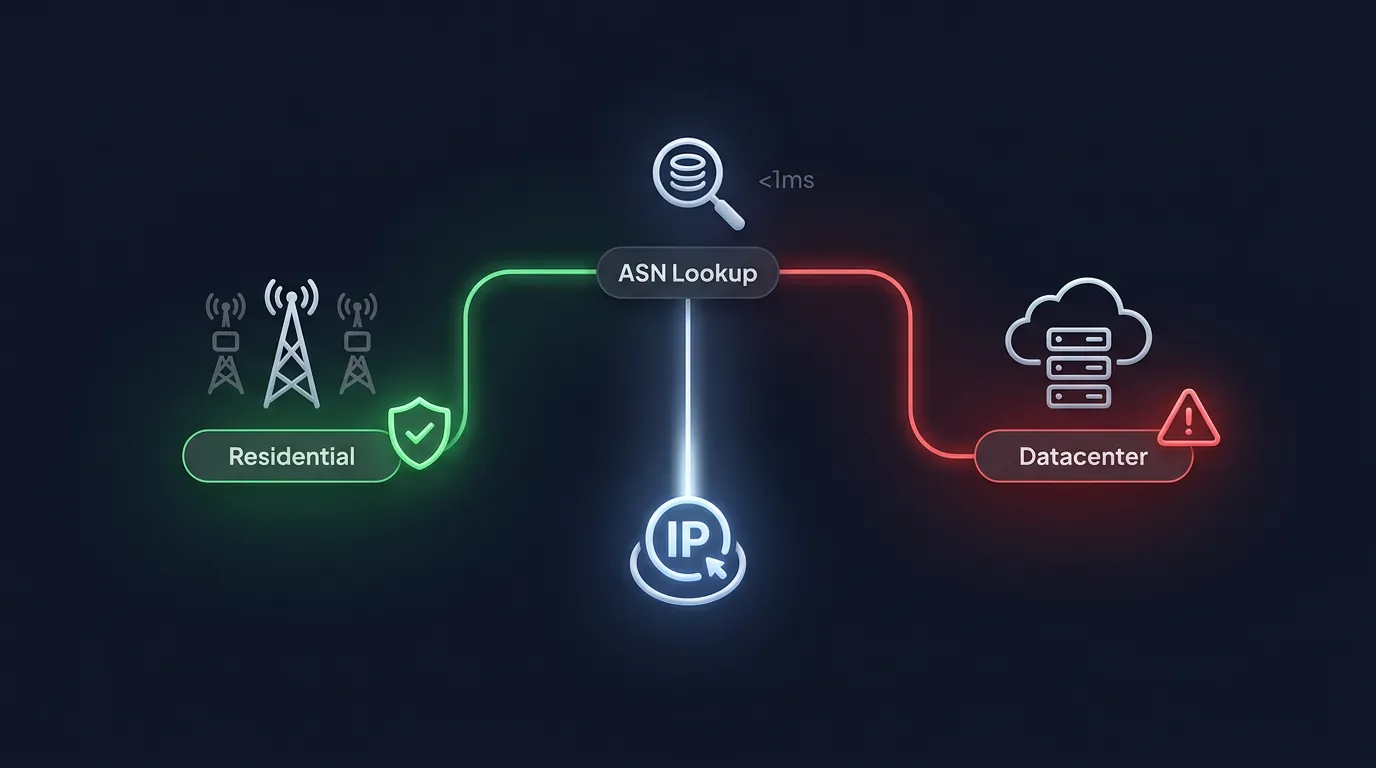
You buy a residential proxy from a reputed provider, assign the correct region—yet the account still hits a checkpoint. Conversely, cheap datacenter proxies cause 50 accounts to get banned overnight. Why?
The difference between residential and datacenter IPs is not just price—it is the ASN (Autonomous System Number), an identifier platforms use to classify IP origins in under 1 millisecond.
In the process of building high-trust accounts on real cloud phones, IP type directly impacts the trust score. The Residential Proxy guide explains setup methods. This article explains the WHY—why platforms flag datacenter IPs via ASN lookups and the role of carrier identity in trust scores.
- Decode ASN—the numeric code revealing IP origins (residential or datacenter)
- Analyze carrier identity—the MCC/MNC mobile network identifier that proxies cannot fake
- Dissect 3-layer cross-validation—why clean proxies alone are insufficient
- Compare simulated scenarios—datacenter vs residential ban rates
- Guide IP verification—using 3 free tools before assigning IPs to accounts
ASN — The True Identity Tag of Every IP Address
ASN (Autonomous System Number) is a unique code assigned to every autonomous network, revealing the owner and intended use of the IP—whether it is a residential ISP or a commercial datacenter.
IANA (Internet Assigned Numbers Authority) allocates ASNs and hardcodes them into BGP routing tables—they cannot be faked or spoofed. When a platform receives an IP address, its first step is an ASN lookup.
ASN lookups return immediate data: the ISP, the datacenter, and the country of origin.
ASN reveals the IP owner—residential ISP or commercial datacenter—and platforms lookup this information in under 1 millisecond.
Residential ASN vs Datacenter ASN — Instant Recognition
ASNs are divided into two primary groups: residential ISPs and commercial hosting (datacenters).
Platforms use IP classification databases—MaxMind GeoIP, IPinfo, IPQualityScore—to check ASNs. Facebook and TikTok cross-check 3 elements simultaneously: ASN × geolocation × historical abuse rate. A fresh IP from OVH (AS16276) carries a high abuse score baseline, getting flagged even with zero spam history.
Why Platforms Trust ASN Over Any Other Signal
ASNs are hardcoded into BGP routing tables—the highest internet routing protocol. While an IP address rotates, the ASN of the network provisioning that IP does not.
Residential proxies borrow IPs from consumer ISPs, keeping the core ASN as "ISP," which platforms trust. Datacenter proxies, despite having clean histories, retain the "hosting" ASN tag, prompting platforms to flag them based on ASN lookup first and IP history second.
Carrier Identity — The Network Layer Proxies Cannot Fake
Carrier identity is a combination of MCC/MNC, APN settings, and VoLTE config—originating from the SIM card and baseband firmware, which proxies cannot replicate.
MCC (Mobile Country Code) + MNC (Mobile Network Code) form a unique ID for every global carrier. 3 specific examples:
- MCC 310/MNC 260 = T-Mobile USA
- MCC 440/MNC 10 = NTT Docomo Japan
- MCC 234/MNC 15 = Vodafone UK
Carrier identity derives from 2 sources: the SIM card (carrying the IMSI with MCC/MNC) and baseband firmware (handling physical mobile network connections). Emulators lack SIM cards, meaning MCC/MNC is absent, completely missing the carrier identity layer.
Platforms cross-check: carrier (MCC) × IP geolocation. Logging in from a USA IP but presenting a UK Vodafone carrier identity triggers a mismatch flag immediately. SentiLink defines this as "carrier × ISP mismatch"—the second strongest fraud signal after device fingerprinting.
ARM-based real cloud phones run actual baseband systems (e.g., Samsung Shannon), providing genuine carrier configurations at the chip level—a core differentiator from baseband-less emulators.
Mobile IP (Carrier CGNAT) — Maximum Trust Level
Mobile IPs routed through Carrier-Grade NAT (CGNAT) achieve the highest trust level: 9.5/10. Thousands of real users share the same carrier IP block, making platforms hesitant to issue bans as it would affect legitimate users.
Costs range from $10-20/IP/month, suitable only for VIP accounts demanding maximum trust. Standard farming accounts using residential IPs ($3-5/IP) comfortably maintain an 8-9/10 trust score.
3-Layer Cross-Validation — Why Clean Proxies Are Not Enough
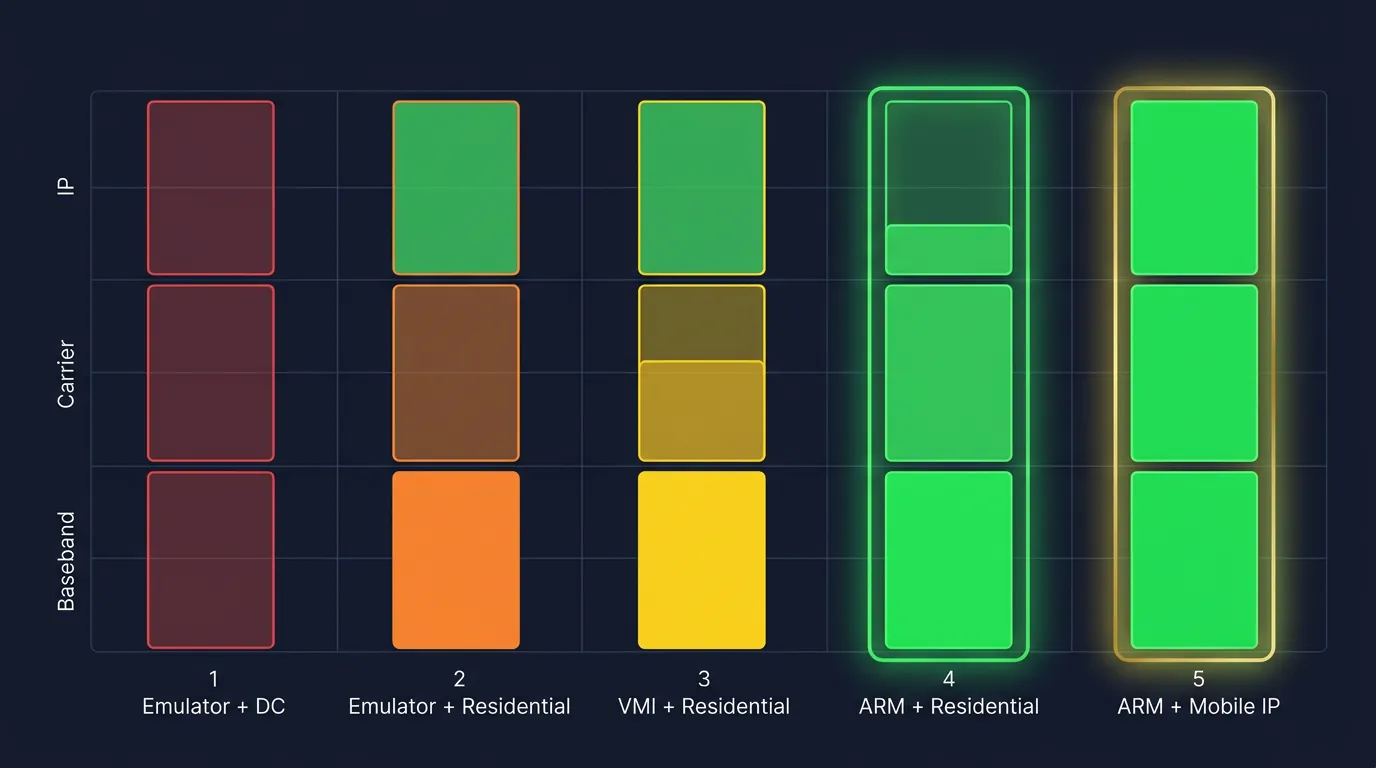
Platforms simultaneously check 3 network identity layers—baseband firmware, carrier config, and IP reputation—cross-referencing them to detect mismatches.
These 3 network identity layers operate in parallel:
- Layer 1 — Baseband firmware: Baseband chips (Shannon, Qualcomm MDM) handle physical network connections. Emulators lack baseband chips, leading to an absent Layer 1.
- Layer 2 — Carrier config: MCC/MNC, APN settings, and VoLTE configurations stem from the SIM and baseband. Emulators lack SIMs, resulting in an absent Layer 2.
- Layer 3 — IP reputation: ASN owner, IP type (residential/datacenter), fraud score, and abuse history. Proxies only fix Layer 3.
Proxies only fix 1 of the 3 network identity layers—pairing a clean residential IP with a device emulator yields 1/3 trust, triggering flags.
Facebook removes over 2.2 billion fake accounts quarterly, according to the Facebook Transparency Report. 3-layer cross-validation acts as the primary mechanism for detecting these fake accounts.
Detailed cross-layer validation—including Shannon baseband firmware and STUN/TURN protocols—is deeply analyzed in the Network Fingerprinting guide.
Simulated Scenario — 1 Account, Datacenter IP vs Residential IP
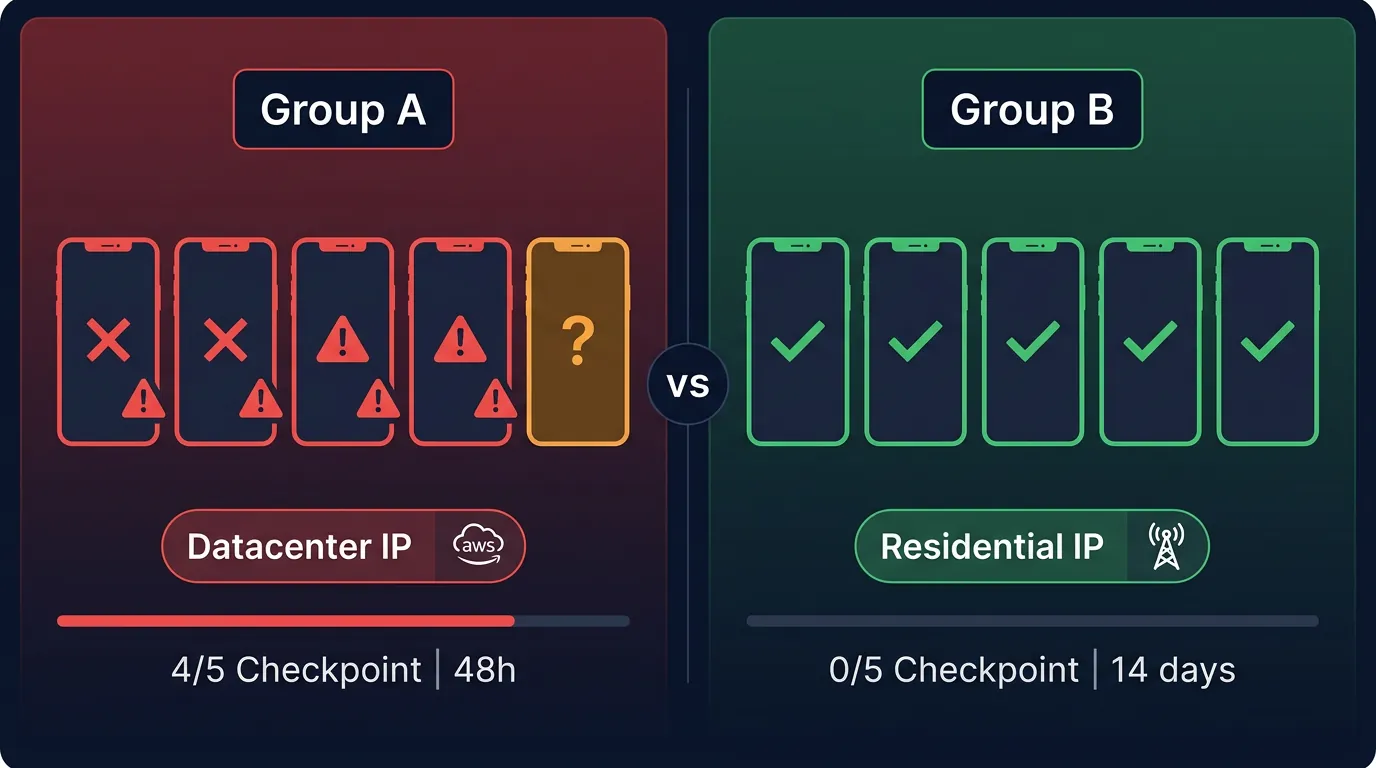
Simulated scenarios (based on Reddit community data and user reports) show that datacenter IPs trigger checkpoints 4-5 times faster than residential IPs when logging into identical Facebook accounts.
Scenario: 10 Facebook accounts, warmed up for 14 days on ARM Cloud Phones, sharing identical profile quality and behavioral patterns. The only varied factor is the IP type:
- Group A (5 accounts, AWS datacenter IP): 4/5 accounts checkpointed after 48 hours. ASN lookup returns AS16509 (Amazon), tagged as "hosting," triggering intensified monitoring and checkpoints.
- Group B (5 accounts, Comcast residential IP): 0/5 accounts checkpointed after 14 days. ASN lookup returns AS7922 (Comcast), tagged as "ISP," passing normal monitoring protocols.
4 out of 5 accounts using datacenter IPs hit checkpoints after 48 hours—0 out of 5 accounts using residential IPs hit checkpoints after 14 days.
Cost-wise, residential is 3-5× more expensive than datacenter ($3-5 vs $0.5-2/IP/month). Weighing alive accounts (positive ROI) against dead accounts (negative ROI) proves residential IPs are highly cost-effective when calculating the total cost per surviving account.
ASN and IP Type Verification Methods
Verify IPs using 3 free tools before assignment: IPQualityScore.com, ipinfo.io, and BGP.tools. Each tool returns the ASN owner, IP type, and fraud score within seconds.
- Access ipinfo.io, input the IP, and check the "org" (ASN owner) and "type" (residential, hosting, or mobile). ASNs belonging to consumer ISPs indicate safe usage.
- Scan IPQualityScore.com, input the IP, and review the 0-100 fraud score. A fraud score under 25/100 is a clean IP—a score above 75/100 indicates a flagged IP that requires discarding.
- Query BGP.tools, input the ASN, and check the abuse score, IP range, and country. An abuse rate exceeding 10% indicates a flagged ASN.
Red flags to avoid include fraud scores above 75, ASNs tagged "hosting" or "VPN," and abuse reports exceeding 10%.
The XCloudPhone proxy dashboard natively displays IP types, ASN owners, and fraud scores, eliminating the need for manual triple-checking.
When Are Datacenter IPs Acceptable?
Datacenter IPs remain suitable for 3 specific use cases not requiring account trust:
- Data Scraping: High speed, massive request volume, and zero trust requirements make datacenter IPs the superior, cheaper choice.
- Testing Automation Flows: QA testing scenarios before assigning residential IPs to real accounts saves costs during the development phase.
- Mock Environments: Testing proxy routing, checking for WebRTC leaks, and benchmarking latency without tying to real accounts.
Datacenter IPs are tools; residential IPs are for accounts. Distinguish the use case strictly before selecting an IP type.
FAQ — IP, ASN, and Carrier Identity
"Will Switching from Datacenter to Residential "Save" a Flagged Account?"
Unlikely. Platforms log historical device and IP correlations. An account that logged in via a datacenter IP permanently holds a low trust score in the system. Switching to a residential IP reduces immediate risk but never resets the trust score to 0. Creating a fresh account with a residential IP from day one yields higher trust scores than rotating proxies mid-way.
"How Does ISP Proxy Differ from Residential Proxy?"
ISP proxies are static IPs hosted in datacenters but registered under consumer ISP ASNs—providing higher trust than pure datacenter IPs but lower trust than rotating residential IPs. ISP proxies are excellent for the active warm-up phase because the IP remains static. Rotating residential proxies are ideal for mass farming where IP diversity is crucial.
"How Many Trust Layers Does an ARM Cloud Phone + Residential Proxy Achieve?"
2 out of 3 layers. Genuine baseband firmware from the SoC (Layer 1) combined with a clean residential IP (Layer 3). Although lacking physical SIM insertion (missing custom Layer 2), the authentic hardware provides a complete device fingerprint. Emulators paired with residential proxies face massive risks due to the complete absence of Layer 1.
"Do VPNs Replace Proxies for Phone Farming?"
No. VPNs utilize shared IP pools, carry ASNs tagged "VPN/Anonymous," and rotate IPs uncontrollably. Platforms detect VPN ASNs faster than datacenter ASNs since VPN providers exist on static blacklists. Dedicated residential proxies outperform VPNs in 3 key metrics for account farming: IP uniqueness, ASN trust, and rotation control.
"Are ASN Checks Free?"
Yes. 3 tools offer free tiers: ipinfo.io (100 queries/day free), BGP.tools (unlimited), and IPQualityScore (500 queries/day free). This tier suffices for operators managing under 100 accounts. For scaling beyond 100 accounts, IPQualityScore's paid API ($9.99/month) allows batch-checking thousands of IPs.
[Special Issue] Carrier Identity — The Forgotten Piece in IP Strategy
The residential vs datacenter debate extends beyond price and quality—the distinction spans 3 specific tiers: ASN fingerprinting (platforms knowing IP origins), carrier identity (MCC/MNC from SIM and baseband), and cross-layer validation (3-layer cross-checks).
Clean proxies solve exactly 1/3 of the puzzle. Real devices (Shannon baseband, genuine carrier configs) are required to achieve maximum trust, clearing 2-3/3 layers.
The Network Fingerprinting guide deeply analyzes baseband firmware and STUN/TURN protocols. The Residential Proxy guide instructions provide detailed setup workflows on real cloud phones. A comprehensive 30-day high-trust farming workflow integrates all 3 elements: real devices, clean proxies, and genuine carrier identities.
👉 Experience undetectable ARM cloud phones with automated proxy integration—start your free trial at app.xcloudphone.com — ~$10/device/month, pay-as-you-go, cancel anytime.
References
- IANA — Internet Assigned Numbers Authority, ASN Assignment Process (iana.org)
- MaxMind GeoIP — IP Classification Database, ASN Lookup API (maxmind.com)
- Facebook Transparency Report — 2.2 Billion Fake Accounts Removed Quarterly, Q4 2024 (transparency.fb.com)
- SentiLink — Carrier × ISP Mismatch Detection Research, 2024 (sentilink.com)
- IPQualityScore — IP Fraud Score Database, Proxy Detection API (ipqualityscore.com)