
Farming 10 accounts is easy. 50 is manageable. But scaling to 1,000 — checkpoint 282 and 956 hit simultaneously, wiping 200 accounts in a single night. Scale is a fundamentally different challenge.
Scaling 1,000 accounts successfully depends on 3 factors: each account running on a dedicated real device (Cloud Phone), residential IPs distributed across subnet rotation, and batch warm-up staggered at least 3 days apart. CP 282 primarily triggers on fingerprint changes (unlock rate 60–90%). CP 956 primarily triggers on IP region shifts (unlock rate 30–50%). A 3-tier hybrid IP strategy reduces IP costs by 50–60%. The fundamentals of warm-up, fingerprint management, and proxy setup are covered in the high-trust account farming guide. This article focuses on 3 challenges unique to scaling 1,000 accounts: IP strategy, batch management, and checkpoint prevention at industrial scale.
In this article, you will learn:
- 5 checkpoint "traps" that 100-account farms never encounter but 1,000-account farms always hit
- Checkpoint 282 vs 956 — mechanisms, triggers, and distinct prevention strategies
- IP strategy for 1,000 accounts — subnet rotation, residential vs mobile, cost matrix
- Batch management — SOPs for grouping, 60-day staggered warm-up
- Real cost + ROI — full breakdown for a 1,000-account farm
By the end, you will have 10 golden rules for checkpoint prevention and a detailed cost table for a 1,000-account operation.
5 Reasons 1,000-Account Farms Fail — Checkpoint "Traps" That 100-Account Farms Never Hit
Facebook does not scan individual accounts at scale — the algorithm uses cluster analysis to detect groups of accounts sharing the same behavior, IP range, and warm-up timing.
Pattern Detection — Facebook Scans "Herd Behavior," Not Individual Accounts
10 accounts acting independently = noise (insufficient sample). 1,000 accounts following the same pattern = a clear signal for anti-fraud algorithms. Facebook applies cluster analysis at scale, identifying account groups that share common characteristics: IP subnet, warm-up timing, action sequences, and online hours.
Trap #1 — Simultaneous warm-up: 200 accounts starting warm-up on the same day, at the same hour, with the same sequence (add photo → like 5 posts → send 10 friend requests). The algorithm detects 200 accounts exhibiting identical behavior within the same time window = red flag.
Trap #2 — Same IP subnet: 50+ accounts sharing the same IP subnet (e.g., 103.45.67.x) → Facebook cross-references and flags immediately. Even if the IP is residential, shared subnet = clear correlation.
Trap #3 — Device fingerprint collision: VMI and emulators generate fingerprints from templates → multiple accounts share the same CPU info, Build.prop, and sensor signature. A real device Cloud Phone has unique hardware: each motherboard carries a different serial → fingerprint unique per device, collision rate 0%. VMI fingerprint collision rate is estimated at 20–30% when using the same template.
Device Fingerprint Collision — 1 VMI Template = 1,000 Accounts With the Same "DNA"
Trap #4 — Fingerprint overlap from VMI: VMI/Emulators generate device fingerprints from preset templates. 100 instances using the same template = 100 accounts with identical hardware "DNA." Anti-fraud aggregates signals: same template + same IP range + same behavior = mass sweep ban.
Trap #5 — SIM and email recycling: Reusing a SIM or email previously linked to a flagged account → the new account "inherits" negative history. At 1,000-account scale, the probability of accidentally reusing a flagged SIM/email increases 10x compared to a 100-account farm.
Checkpoint 282 vs 956 — Mechanisms, Triggers, and Distinct Prevention Strategies

Checkpoint 282 requires photo verification — the primary trigger at scale is sudden device fingerprint changes and duplicate stock photos across accounts. Checkpoint 956 requires identity document verification — the primary trigger is IP region jumping and datacenter IP detection.
Checkpoint 282 — Photo Verification: When It Triggers and How to Prevent It
Checkpoint 282 (CP 282) requires uploading a selfie matching the profile picture — moderate severity, with a 60–90% unlock rate when appealed correctly.
Trigger conditions at 1,000-account scale:
- Device fingerprint change — Switching devices, changing emulators, or restarting a VMI instance = new fingerprint → Facebook requests verification
- Duplicate stock photos across accounts — 50 accounts using the same downloaded stock profile photo → AI detects cross-account photo matches
- Competitor reports — Competitors file tactical reports, triggering manual review
- Policy-violating content — Posting copyrighted or trademarked material
Prevention: Keep fingerprint consistent on Cloud Phone (do not change IMEI/Android ID after warm-up), use unique profile photos for each account (no stock photos), avoid sharing copyrighted content.
Recovery when hit with CP 282: Upload a clear photo + supporting documents, appeal from the same device = unlock rate 60–90%. Processing time: 24–72 hours.
Checkpoint 956 — The Vault Lock: IP Is the #1 Cause
Checkpoint 956 (CP 956) locks the account entirely, requiring identity document verification — highest severity, with a 30–50% unlock rate.
Trigger conditions at 1,000-account scale:
- IP region jumping — An account registered with a Vietnam IP suddenly logging in from a US IP. At 1,000 accounts, IP management errors = many accounts experiencing simultaneous IP shifts
- Shared datacenter IP — An IP used by multiple accounts, appearing on Facebook's blacklist
- Login spike — 100+ accounts logging in simultaneously from the same IP range (e.g., after a server restart)
- Session interruption — VPS restart, emulator crash → session breaks → mass re-login
Prevention: Fixed residential IP per account, no datacenter IPs, 24/7 session continuity (Cloud Phone advantage — no restarts, no crashes, 99.7% uptime).
Recovery when hit with CP 956: Submit government ID/passport, route IP back to the registration country, golden window is the first 24 hours — unlock rate drops 50% after 48 hours.
Prevention Checklist — 10 Golden Rules for Farming 1,000 Accounts
These 10 rules apply at industrial scale — each prevention rule blocks 1 or more checkpoint triggers.
- Assign 1 dedicated residential IP per account — never share an IP between any 2 accounts
- Keep fingerprint consistent — do not change IMEI, Android ID, or device info after warm-up
- Stagger warm-up by batch — never warm up more than 150 accounts simultaneously
- Use unique profile photos — no stock photos, no duplicate photos between any 2 accounts
- Enable 2FA on day 1 — no delays, each account linked to a separate SIM or authenticator app
- Limit actions to 200/day/account — including likes, comments, shares, and friend requests
- Add random delay of 30–120 seconds between actions — no fixed intervals
- Avoid posting links for the first 14 days — no URLs of any kind during warm-up phase
- Monitor checkpoint flags daily — check daily alerts, never ignore warnings
- Appeal within 24 hours when checkpointed — unlock rate decreases significantly after 48 hours
IP Strategy for 1,000 Accounts — Subnet Rotation, Residential vs Mobile, Cost Matrix
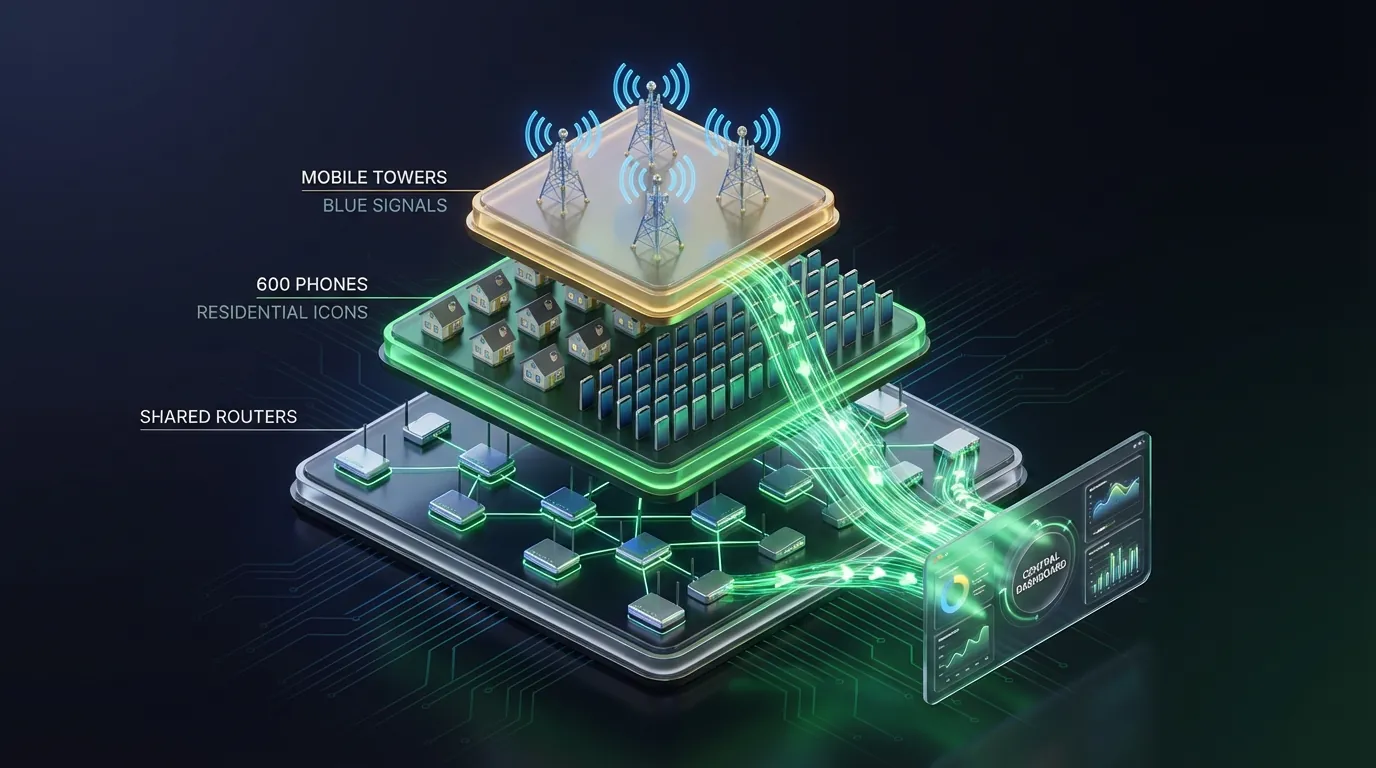
IP strategy determines 50% of success when farming at scale — choosing the wrong IP will trigger checkpoint 956 in waves, even with perfect fingerprint and warm-up execution.
The difference between residential and datacenter IPs directly impacts trust score — similar to the difference between a real device Cloud Phone and VPS Android at the device layer.
Residential IP vs Mobile IP vs Datacenter IP — Selection Matrix
Subnet Rotation — Why You Should Never Buy 1,000 IPs From the Same Provider
1,000 IPs on the same subnet (e.g., 103.45.67.x) → Facebook detects correlation between all accounts on that IP range. Rule of thumb: maximum 50 accounts per subnet, distribute evenly cross-subnet.
Distribution strategy:
- Split IPs into 5–10 pools from 3+ different providers: IPRoyal, BrightData, and Proxy-Seller
- Each pool: different ASN (Autonomous System Number) — different backbone carrier
- Each batch of accounts mapped to 1 dedicated IP pool — no cross-pool sharing
Cost Optimization — Hybrid IP Strategy for a 1,000-Account Farm
100% residential IP for 1,000 accounts = $3,000–5,000/month → expensive. A tiered hybrid strategy reduces costs by 50–60%:
Batch Management — Grouping SOPs and Staggered Warm-Up for 1,000 Accounts
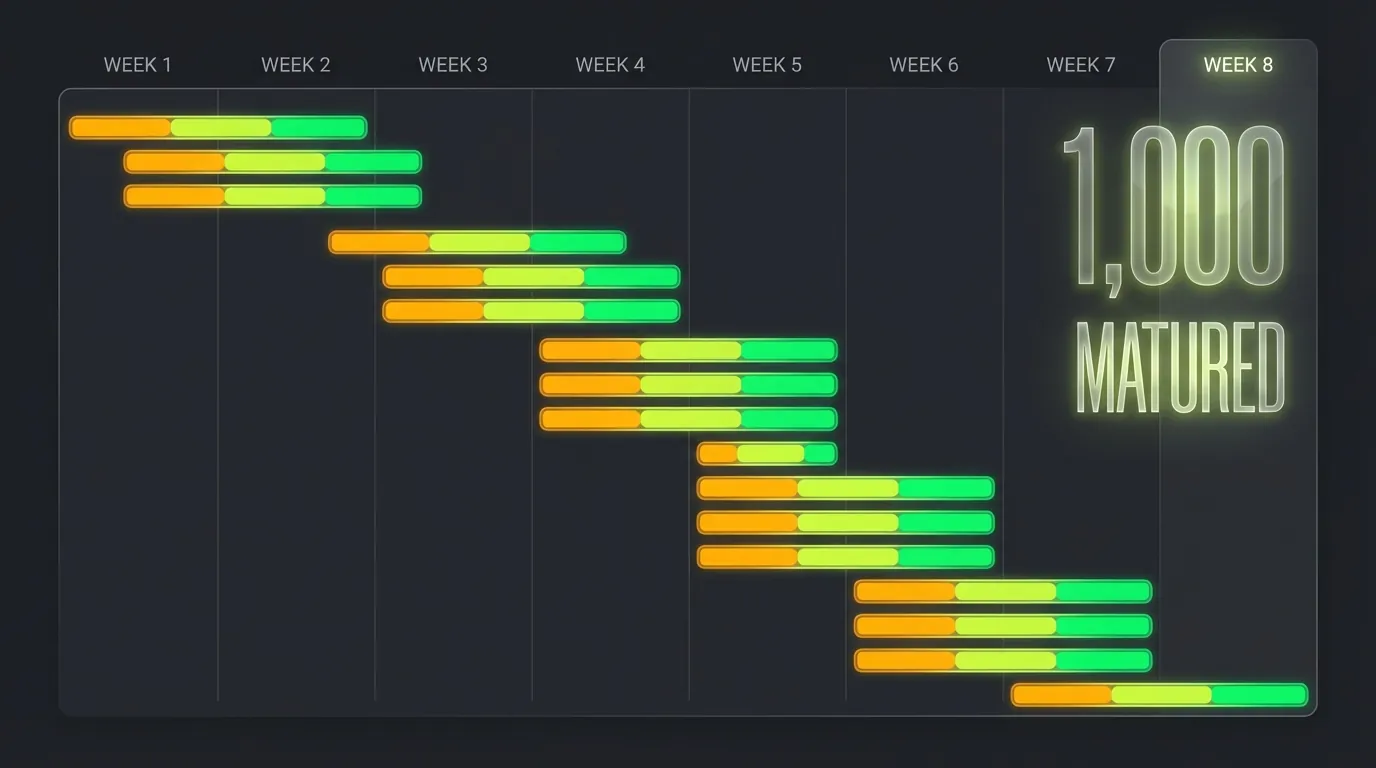
A system of 1,000 accounts divides into 20 batches of 50 accounts each, each with a dedicated IP pool and a separate warm-up timeline — no batch overlaps the warm-up phase of another.
Dividing 1,000 Accounts Into 20 Batches — Blueprint
1,000 accounts ÷ 50 accounts/batch = 20 batches. Each batch is assigned:
- Dedicated IP pool — 1 batch = 1 subnet/provider
- Separate warm-up timeline — each batch starts 3–7 days after the previous batch
- Specific use case — Tier 1 (premium), Tier 2 (standard), or Tier 3 (expendable)
- Naming convention:
Batch-01-FB-US-Mar2026,Batch-02-FB-UK-Mar2026
Each batch is assigned to 1 team member (agency setup). Metadata tracking via spreadsheet or Cloud Phone dashboard — batch ID, start date, IP pool, current phase, checkpoint count.
Staggered Warm-Up — 60-Day Schedule for 1,000 Accounts
Rule: Never warm up more than 150 accounts simultaneously — stay under 150 accounts/wave to avoid pattern detection.
Each batch follows the 4-Phase process outlined in the high-trust account farming overview: Setup → Warm-up → Trust Building → Maturation.
Monitoring Dashboard — Daily KPIs
5 KPIs tracked per batch:
- Checkpoint rate: Target below 5% per batch — if exceeding 10% → STOP warm-up for that batch, review IP pool
- Account survival: Target above 95% per batch — check weekly
- Average friends: Must increase by phase — Phase 1: 0–20, Phase 2: 20–100, Phase 3: 100–300
- Post reach average: Target above 50 reach/post when matured — below 20 = shadow ban
- IP health: Check IP blacklist status daily — use IP reputation tools
Alert system: Checkpoint rate exceeds 10% for any batch → automatically pause warm-up for that batch, trigger review of IP pool and fingerprint settings. Cloud Phone dashboard Sync Control displays all batches with status filtering.
Operating Cost for 1,000 Facebook Accounts on Cloud Phone — Full Breakdown
Operating 1,000 accounts on Cloud Phone costs $9,500–23,400/month — covering devices, IP, SIM, and personnel.
Monthly/Annual Cost Summary
For comparison: a physical phone farm with 1,000 devices = $50,000+ setup investment + $5,000–10,000/month operating costs + office space, electricity, and staff to manage physical hardware. Cloud Phone requires no upfront hardware investment.
ROI by Scenario — When Does a 1,000-Account Farm Break Even?
4 monetization scenarios for a 1,000-account farm:
- Affiliate marketing: 1,000 accounts × $5 commission/account/month = $5,000/month → ROI: 2–4 months
- Agency seeding: Charge $50–100/campaign × 20 campaigns/month = $1,000–2,000 → ROI: 4–6 months
- E-commerce seeding: 1,000 accounts seeding for 50 stores → revenue lift of 20–30% for clients
- Airdrop/Crypto: Variable — depends on token price, typically ROI-positive from month 1 on the right project
Frequently Asked Questions About Scaling 1,000 Facebook Accounts
"What Hardware Does a 1,000-Account Farm Need?"
A real device Cloud Phone is the most cost-effective option for 1,000 accounts — no upfront hardware investment (box farm = $50,000+), no managing x86 VPS instances (ban risk 30–50%). Each Cloud Phone = 1 real Samsung, unique fingerprint, checkpoint rate below 5%.
"Is Farming 1,000 Facebook Accounts Illegal?"
Running multiple Facebook accounts violates Meta's Terms of Service — it does not violate any national or international law. The consequence is account bans, not legal prosecution. Many agencies and businesses operate account farms for marketing, seeding, and customer service.
"Why Do Accounts Still Get Checkpointed Even With Residential IPs?"
3 reasons: too many accounts on the same subnet (>50 accounts/subnet), low IP quality (provider already flagged), or correct IP but wrong device (VPS x86 + residential proxy — only solves 1 out of 5 detection layers). Check ASN diversity and device fingerprint simultaneously.
"Can You Warm Up 1,000 Accounts Simultaneously?"
No — warming up 1,000 accounts simultaneously triggers pattern detection from Facebook. Stagger warm-up by batch: 150 accounts/wave, 3–7 days apart. Total time to mature all 1,000 accounts: 56–63 days (8–9 weeks on the staggered schedule).
"Is Appealing Checkpoint 282 Easier From a Cloud Phone?"
Yes — appealing CP 282 from the same device (a fixed Cloud Phone) achieves an unlock rate of 60–90%, higher than appealing from a different device (30–50%). Facebook cross-checks device fingerprint during appeal processing — consistent fingerprint = positive signal.
"How Many Automated Actions Per Day Are Safe for Large Farms?"
200 actions/day/account is the safe threshold — including likes, comments, shares, friend requests, and messages. Random delay of 30–120 seconds between each action. Large farms need additional variation: each batch on a different schedule, avoiding 1,000 accounts all active during 8AM–10AM.
"Should You Use Real SIMs or Virtual Numbers for 1,000 Accounts?"
Real SIMs for Tier 1 accounts (premium, high-value) — highest trust. Virtual numbers (TextNow, TextFree) for Tier 3 accounts (expendable, test) — cheaper but lower trust, checkpoint rate 20–30% higher. Recommended split: 60% real SIMs, 40% virtual numbers.
"How Do You Prepare for Checkpoint Waves?"
Facebook runs sweep bans in large waves — typically during Q1 and Q3, based on observed patterns from 2023–2026. Preparation: reduce activity by 50% for 2 weeks before each new quarter, check IP health daily, and pause new batch warm-up when a checkpoint wave is detected in progress.
From 1 Account to 1,000 — Safe Scaling Roadmap on Real Cloud Phones
Scaling 1,000 accounts successfully rests on 3 pillars: real devices (ARM Cloud Phone), clean IPs (residential hybrid), and batch discipline (staggered warm-up). Missing any 1 of the 3 = mass checkpoints.
5 steps to scale from 100 to 1,000:
- Start with 100 accounts on Cloud Phone — validate your warm-up process, measure baseline checkpoint rate
- Set up a hybrid IP strategy — 3+ providers, subnet rotation, ASN diversity
- Divide 1,000 accounts into 20 batches — staggered warm-up over 60 days, 150 accounts/wave
- Deploy safe automation — 200 actions max, random delay 30–120 seconds, human-like patterns
- Monitor KPIs daily — checkpoint rate below 5%, account survival above 95%, IP health checks
The decision comes down to 1 question: How many live accounts does your farm need to stay ROI-positive? 1,000 accounts × 95% survival = 950 active accounts. Each active account generates $5–15/month in revenue → a 1,000-account farm generates $4,750–14,250/month.
Start with XCloudPhone — 1,000 real devices, each account on a dedicated Samsung.
References:
- Facebook Transparency Report — Meta Transparency Center
- Meta Business Account Quality — Meta Business Guidelines
- Residential Proxy Benchmark 2026 — Proxyway
- Play Integrity API — Android Developer Documentation