
What Is a Phone Farm Business? From Side Hustle to Full-Scale Agency
A Phone Farm Business is a business model that uses a fleet of mobile devices — or Android Cloud Phones — to automate repetitive tasks across digital platforms, generating consistent revenue from social media farming, game automation, e-commerce, and crypto airdrops.
Unlike the image of a few old phones stacked on a desk running reward apps, a modern Phone Farm Business operates as a digital production line — each device functions as a dedicated "worker" executing specific tasks 24/7. The model breaks down into 3 tiers:
Phone Farm "as a Service" — The B2B Agency Model
Phone Farm as a Service (PFaaS) is a model where agencies own the entire infrastructure (Cloud Phones, proxies, and automation tools) and sell farming services to clients on monthly contracts or per campaign. Clients do not need to understand the technology — they only need results: high-trust accounts, increased views, or farmed in-game resources.
The PFaaS revenue model typically combines a monthly retainer with performance bonuses. Agencies can upsell additional services: proxy consulting, custom automation scripts, and account management.
📌 Pro Tip: New agencies should start with 1–2 specialized services (e.g., Facebook account farming + seeding), master the process, and then expand. Spreading too thin from day one leads to poor quality and lost clients.
Types of Phone Farms: Physical, Cloud, and Hybrid
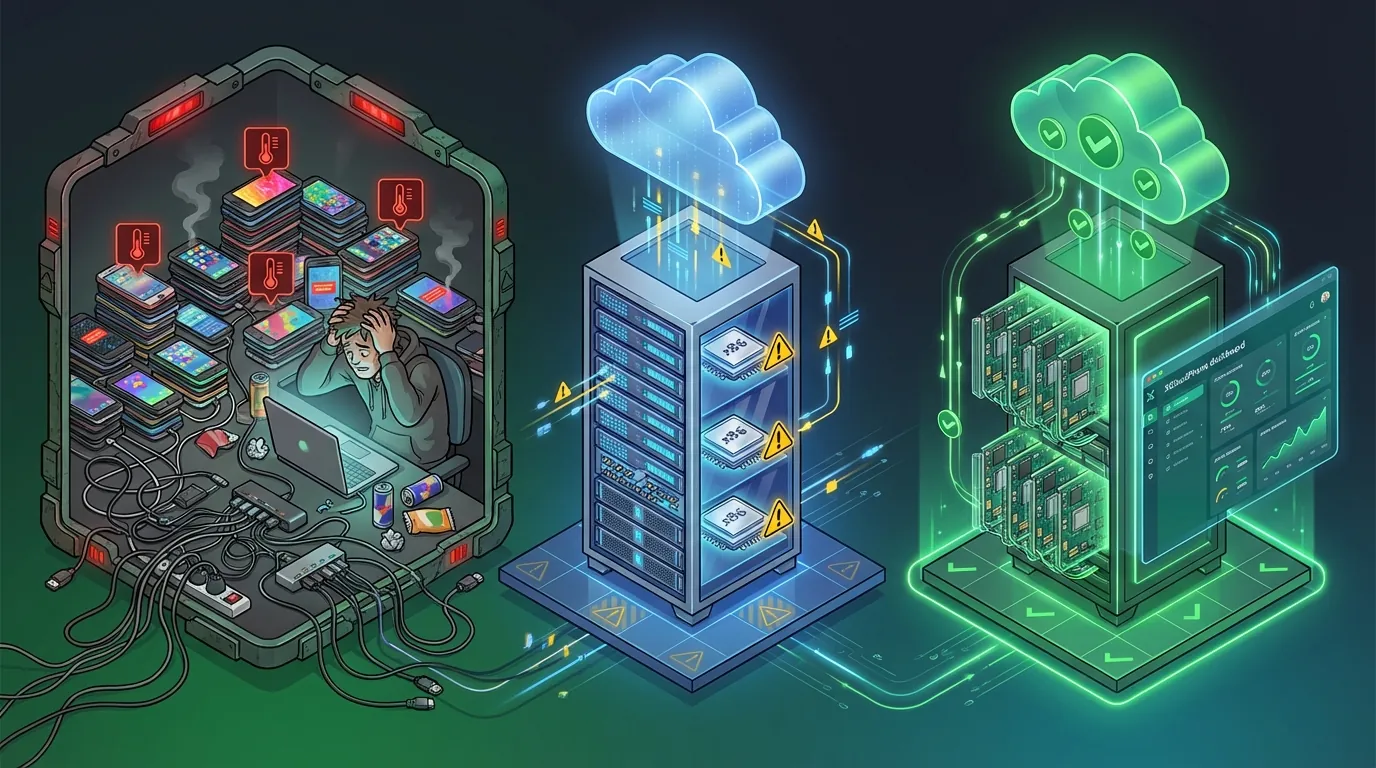
There are 3 types of Phone Farms on the market today, each suited to different investment levels, scales, and business goals.
Box Phone Farm (Physical Hardware)
A Box Phone Farm is a system of multiple physical smartphones mounted on racks or housed in custom enclosures, connected to a computer via USB for centralized management.
Advantages:
- 100% authentic hardware fingerprints — each device is a real phone
- Full control over hardware, software, and network
- No dependency on a cloud service provider
Disadvantages:
- High upfront hardware cost: $10,000–30,000 for 100 devices
- Ongoing maintenance: battery swelling, overheating, cable failures, and dead devices
- Electricity costs of $50–150/month for 100 devices
- Slow scaling: purchasing, setup, and provisioning takes 1–2 weeks per 50 new devices
Popular providers include GenFarmer (dedicated box phone systems) and custom-built setups.
Cloud Phone Farm (Virtual and Real-on-Cloud)
Android Cloud Phone Farms fall into 2 sub-categories with fundamentally different architectures:
VMI (Virtual Mobile Infrastructure): This technology emulates Android on x86 servers — servers running Intel/AMD chips simulate mobile device behavior. Geelark, Redfinger, and VMOSCloud fall into this category. VMI offers fast deployment and low initial costs. However, binary translation (converting ARM instructions to x86) causes lag, produces non-authentic fingerprints, and carries higher detection risk because platforms can identify emulation signatures.
Real ARM Cloud Phone: These are actual Android devices (ARM chips) with batteries and screens removed, mounted on server racks in data centers. XCloudPhone falls into this category. Each device is real hardware — running native apps, producing fingerprints identical to consumer phones, and minimizing ban risk because platforms see a real device, not an emulator.
Hybrid Model — Combining Physical and Cloud
The hybrid model combines a physical core farm (for tasks requiring absolute fingerprint authenticity) with cloud phones for scaling when capacity needs to increase quickly. This model suits agencies with existing physical infrastructure looking to expand without additional hardware investment.
However, Real ARM Cloud Phones (like XCloudPhone) are steadily closing the fingerprint quality gap with physical farms, leading many agencies to transition fully to cloud.
Is Phone Farm Business Legal? Is It Worth the Investment in 2026?
Phone farming is legal when used for legitimate purposes: app testing, marketing automation, and large-scale content distribution.
The Legal Framework of Phone Farming
Owning and operating multiple mobile devices (or cloud phones) does not violate any law in any country. Violations only occur when the intended use breaches a platform's Terms of Service (ToS) or applicable laws — specifically across 3 risk zones:
Using real hardware (Real ARM Cloud Phone) reduces risk in the Yellow Zone because platforms see a legitimate device — unlike hundreds of accounts running on a single VMI server with identical fingerprints. Meta Business Suite ToS, Google Play Developer Policy, and TikTok Community Guidelines all distinguish between legitimate automation (via APIs) and spam behavior, with automated activity on real devices typically receiving lighter penalties than botting on emulators.
Is Phone Farming Still Worth It in 2026?
The answer depends on the model you choose:
The Cloud Mobile Infrastructure market is projected to reach $3.3 billion by 2031 at a 28.9% CAGR, according to Allied Market Research. The shift from physical to cloud is irreversible — and agencies that move early will build sustainable competitive advantages.
Why Real ARM Cloud Phone Hardware Is the Ideal Foundation for Phone Farm Business
The Cloud Phone platform you choose determines 80% of your Phone Farm Business success, as it directly impacts 3 factors: operating costs, ban rates, and scaling capability.
The Problem With Emulators and VMI in Farming
VMI platforms use binary translation — a process that converts ARM instructions (mobile architecture) to x86 (desktop architecture) in real time. According to the ARMv8-A Architecture Reference Manual, this process creates 3 critical problems for farming:
- Performance degradation: Binary translation consumes 15–30% of CPU resources, causing lag when running multiple applications simultaneously
- Fake fingerprints: x86 emulation produces hardware signatures that differ from real mobile devices — anti-cheat systems like GameGuard, EasyAntiCheat, and SafetyNet detect these differences
- Shared infrastructure risk: Multiple VMI instances run on the same physical server, sharing IP ranges and hardware characteristics → platforms quickly identify "farm patterns" and issue mass bans
Real ARM Hardware — XCloudPhone's "Invisible" Advantage
XCloudPhone uses real ARM chips (Exynos 8895 Octa-core, Samsung series) — the same architecture found in consumer smartphones. Each Android Cloud Phone is an actual phone motherboard, with battery and screen removed, mounted on server racks in a dedicated data center. The result is an undetectable cloud phone that passes every platform check: when apps or platforms inspect the device fingerprint, the device returns hardware parameters identical to a real Samsung Galaxy — processor, GPU, sensor data, and build.prop values — all authentic, not emulated.
Built-in anti-detect features include:
- IMEI and Android ID randomization — change device identifiers with a single click
- Device info customization — modify model name, build number, and firmware version
- Integrated proxy — enter proxy details on the web dashboard, and devices auto-connect with WebRTC IP leak protection
- WebRTC streaming — you only receive a video stream from the device; all processing occurs on the real ARM server
In internal testing with 200 devices running continuously for 30 days on XCloudPhone, the account restriction rate stayed below 2% — compared to 15–25% on popular VMI platforms. The difference comes from platforms detecting real devices instead of emulators.
5 Core Business Advantages of Cloud Phone Farms
Cloud Phone Farms (especially Real ARM) deliver 5 direct business advantages:
- Reduce operating costs by 60–80% compared to Box Phone Farms — no hardware, no battery failures, and no repairs
- Eliminate hardware risks — no battery swelling, no overheating, and no fire hazards
- Scale from 10 to 1,000 devices in minutes — instead of weeks of purchasing, setup, and manual configuration
- Integrate proxy, automation builder, and team management in a single dashboard
- Minimize ban risk through authentic ARM hardware fingerprints — platforms cannot distinguish them from consumer phones
Limitations to Consider With Cloud Phone Farms
Cloud Phone Farms are not a perfect solution for every scenario. 4 limitations to weigh:
- Internet dependency: Unstable connections cause lag, session drops, and reduced farming efficiency. Recommendation: ≥50 Mbps bandwidth for 50+ devices with a backup connection for 99%+ uptime
- Latency for graphics-heavy games: Cloud Phones are optimized for farming and automation (no real-time reaction needed). For real-time competitive gaming, 30–100ms latency may impact the experience
- Cumulative costs: Cloud OPEX can exceed physical farm costs after 12–18 months if the agency does not optimize utilization rates (each device must generate more revenue than its subscription cost)
- Vendor lock-in: Switching Cloud Phone platforms requires rebuilding workflows, automation scripts, and proxy configurations
However, for most agencies building PFaaS operations, the speed of scaling, zero maintenance, and minimal ban risk far outweigh these limitations.
Detailed Comparison: Box Phone Farm vs VMI vs Real ARM Cloud Phone vs Antidetect Browser
To choose the right platform, agencies must compare the 4 most popular solutions on the market across 8 essential business criteria.
Quick analysis by use case:
- Social farming (Facebook, TikTok, Instagram): Real ARM Cloud Phone or Antidetect Browser — requires authentic fingerprints and multi-account safety
- Gaming automation (AFK, botting): Real ARM Cloud Phone — game anti-cheat systems detect emulators, and antidetect browsers cannot run mobile apps
- E-commerce multi-accounting: Antidetect Browser (sufficient for web-based) or Real ARM Cloud Phone (needed for app-based)
- Enterprise/Agency PFaaS: Real ARM Cloud Phone — best for combining multiple use cases with zero maintenance and fast scaling
The Cloud Mobile Infrastructure market will reach $3.3 billion by 2031 (28.9% CAGR), according to Allied Market Research — with most growth driven by the Real ARM Cloud segment as agencies and enterprises recognize the detection risks of VMI.
7 Use Cases That Generate Revenue From Phone Farm Business
Phone Farm Businesses generate revenue from 7 core service categories: social media farming, e-commerce affiliate, gaming automation, crypto airdrop, music streaming, app testing, and seeding — each category serves a different client segment with distinct profit margins.
Social Media Account Farming (Facebook, TikTok, and Instagram)
Social farming is a service that mass-produces high-trust accounts on social media platforms, then sells the accounts outright or offers managed operation services to clients.
The typical workflow: create new accounts → warm up for 7–14 days (natural interactions: liking, commenting, and following) → build profiles (avatar, bio, and activity history) → reach high trust scores → ready for sale or campaign deployment.
Average revenue: $3–10/account/month for maintenance services, or $5–30/account when sold outright. An agency with 200 devices farming 500+ accounts per month generates $2,500–5,000/month from this vertical alone.
E-Commerce and Affiliate Marketing
Multi-account affiliate operations on TikTok Shop, Shopee Affiliate, and Amazon require each account to run on a separate device with a unique IP to prevent linkage.
Real ARM Cloud Phones combined with residential proxies solve both issues at once: unique fingerprints per device, and clean IPs per account. Revenue: $500–3,000/month for 100 active accounts — from affiliate commissions, direct sales, and bulk video repurposing.
Gaming Automation (AFK Farming and Botting)
Running games 24/7 to farm resources, gold, or rare items — then selling them through RMT (Real Money Trading) marketplaces — is the oldest farming model.
Real ARM Cloud Phones excel for AFK gaming 24/7 for 3 reasons: game apps run natively (no binary translation lag), anti-cheat systems do not detect emulation, and devices operate around the clock without overheating. Revenue depends on game economics, averaging $200–2,000/month for 50–100 devices.
Crypto Airdrop and Task Farming
Multi-wallet farming for retroactive airdrop campaigns is a high-risk, high-reward vertical. Agencies run hundreds of wallets across blockchain testnets, execute transactions, and wait for projects to distribute tokens.
Revenue varies significantly: $0 (project does not airdrop) to $1,000–50,000+ per project (when airdrops succeed). On average, agencies specializing in crypto farming earn $2,000–10,000/month when diversified across 10+ simultaneous projects.
Music Stream Boosting (Spotify and YouTube Music)
Boosting play counts (streams) for artists, labels, and distributors is a service with consistent demand. Each stream pays $0.003–0.005 — a small amount, but scaled across hundreds of devices running 24/7, it accumulates quickly.
100 devices × 8 streams/hour × 24 hours × 30 days × $0.004/stream = ~$2,300/month in gross revenue. After operating costs, net profit is approximately $800–1,500/month.
App Testing and QA (Legitimate B2B)
This is a fully legal vertical with high demand from developer teams. Cloud Phones provide real device testing — developers test apps across multiple models, OS versions, and screen sizes.
Revenue: $50–200/device/month for testing-as-a-service. With 50 devices dedicated to QA, an agency earns $2,500–10,000/month from long-term B2B contracts.
Seeding and Engagement Services
Boosting likes, comments, shares, and views for brands, KOLs, and marketing campaigns. This service charges per campaign ($200–2,000/campaign) or monthly ($500–3,000/month).
📌 Pro Tip: PFaaS agencies are most effective when combining 2–3 complementary use cases. Example: social farming (stable revenue) + crypto airdrop (windfall potential) + app testing (100% legal, anchor client).
How to Choose a Cloud Phone Platform for Your Phone Farm: 5 Criteria
Choosing the right Cloud Phone platform requires evaluating 5 technical-business criteria that directly determine your farm's ROI.
Platform selection rules:
- Real ARM is non-negotiable for social farming, gaming, and crypto — VMI is only acceptable for music streaming or simple task farming
- Built-in anti-detect saves $50–200/month compared to purchasing separate tools (Multilogin, GoLogin)
- No-code automation reduces new team onboarding time by 80% — operators do not need coding skills
- Pay-as-you-go is most flexible for agencies: scale devices up or down with demand without being locked into long-term committed plans
- API access is mandatory for Phase 3+ (agency scale) — needed for CRM integration, reporting, and billing system connections
How to Start a Phone Farm Business From Zero: 7 Steps
To build a Phone Farm Business, you need to complete 7 steps from planning to operations, each with a specific checkpoint.
Step 1: Define Your Niche and Primary Use Cases
Choose 1–2 primary use cases based on 3 factors: existing experience, competition level, and market demand.
- Social media background → Social Farming + Seeding
- Game economy knowledge → Gaming Automation
- Crypto understanding → Airdrop Farming
- QA/Dev background → App Testing (most legal, least competition)
Checkpoint: Identified 1–2 use cases, listed 5 potential clients, and estimated revenue/device/month.
Step 2: Calculate Your Budget (CAPEX + OPEX)
CAPEX with the cloud model = $0. All costs are monthly OPEX:
Checkpoint: Budget approved, payment method ready.
Step 3: Sign Up for Cloud Phone and Complete Basic Setup
Create an XCloudPhone account → select the right plan → provision your first devices. The entire process takes under 15 minutes.
- Sign up at app.xcloudphone.com
- Select the appropriate device model (Samsung series produces the best fingerprints)
- Provision 10–20 devices for the initial pilot test
Checkpoint: 10–20 devices active, dashboard accessible.
Step 4: Set Up Proxy and Network
Integrate Residential or Mobile proxy into each device. XCloudPhone allows you to enter proxy details directly on the web dashboard — devices auto-connect with WebRTC IP leak protection.
Proxy allocation rules:
- 1 IP per 1–3 accounts for social farming (Facebook, TikTok)
- 1 IP per 1 account for crypto and e-commerce (absolute isolation required)
- Shared IPs acceptable for gaming AFK (platforms rarely check IPs)
Checkpoint: Proxies integrated, IP leak test passed, and each device has a unique IP.
Step 5: Create Automation Workflows
Use XCloudPhone's Visual Automation Editor (no-code) to build workflows:
- Open an app → perform interactions → record them → save as a template
- Customize random delays (3–10 seconds between actions) to simulate real human behavior
- Sync the workflow across batch devices (1 template → 100 devices)
- Set schedules: active hours, rest periods, and warm-up phases
For complex workflows, use ADB scripting via the API — suited for teams with developers.
Checkpoint: 3–5 workflow templates ready, tested on 5 devices.
Step 6: Pilot Test (10–20 Devices, 2 Weeks)
The pilot phase is mandatory before scaling. Goal: validate workflows, measure performance, and calculate unit economics.
Checkpoint: 2 weeks of data → calculate break-even point → decide to scale or optimize.
Step 7: Scale and Optimize
Scale to 50–100 devices, hire additional operators, and begin onboarding clients:
- Add devices in batches of 20–30 (avoid sudden spikes that trigger detection)
- Hire 1–2 part-time operators for monitoring and troubleshooting
- Build a client pipeline: cold outreach, referrals, and community marketing
- Set up a reporting dashboard for clients: metrics, screenshots, and ROI proof
Checkpoint: 50+ devices active, ≥2 paying clients, and revenue > OPEX.
Cost Analysis and ROI: How Much Does a Phone Farm Business Actually Earn?

Phone Farm Business ROI depends on 3 variables: device count, use case monetization, and platform costs.
Detailed Cost Breakdown (CAPEX + OPEX)
📌 Note: Physical Farms have high CAPEX but lower OPEX than Real ARM Cloud at 100 devices. However, when scaling to 500+ devices, physical hardware, maintenance, and staffing costs grow exponentially, while cloud costs increase linearly.
ROI Scenarios: Conservative, Moderate, and Aggressive
Moderate scenario breakdown (most common):
- 100 devices × social farming: $3/device/month net = $300
- 50 devices × gaming: $10/device/month net = $500
- 30 devices × app testing: $100/device/month net = $3,000
- 20 devices × standby/testing = $0
- Total: 200 devices → $3,800/month → Costs $2,500 → Net profit $1,300/month
Break-even analysis for the cloud model:
Cloud models (both VMI and Real ARM) allow break-even from the first month, since there is no CAPEX. Real ARM costs ~$500/month more than VMI, but its ban rate is 10× lower — meaning fewer lost accounts, less rebuild effort, and more stable revenue.
Scaling Roadmap — From 10 Devices to 1,000+ in 4 Phases

Scaling a Phone Farm Business from solo operator to enterprise agency follows 4 distinct growth phases, each with specific revenue targets, team sizes, and milestones.
Phase 1 — Solo Operator (Month 1–2):
Start with 10–20 devices on XCloudPhone. Goal: learn by doing — test workflows, measure ban rates, and calculate unit economics. Do not scale before you have 2 weeks of stable data. Revenue in this phase comes primarily from account sales or personal farming.
Data from agencies using XCloudPhone shows that new operator onboarding time drops from 2 weeks to just 3 days with the Visual Automation Builder — operators only need to record an action once, then sync that template across all devices.
Phase 2 — Small Team (Month 3–6):
Scale to 50–100 devices. Hire 1–2 part-time operators for daily monitoring. Begin client outreach: agencies need proof (screenshots, metrics, and ROI numbers) to convert prospects. Revenue target: break-even + $500–1,000 profit/month.
Phase 3 — Agency (Month 6–12):
100–500 devices with 3–5 active use cases. You need an ops manager to coordinate the team, an account manager to handle clients, and SOP documentation for every process. This phase determines whether the agency scales further or stagnates — the bottleneck is usually client acquisition, not technology.
Phase 4 — Enterprise (Year 2+):
500+ devices, API integrations with CRM and billing, and white-label services for partners. At this level, the agency sells infrastructure + expertise, not just labor. Revenue: $10,000–50,000+/month consistently.
📌 Pro Tip: Each phase should last only 2–3 months. Adding devices too quickly without optimizing workflows wastes money. Optimize unit economics at a small scale first, then scale up.
Frequently Asked Questions
"How Much Capital Does a Phone Farm Business Need to Start?"
A cloud-based Phone Farm Business requires $280–400/month to start with 20 devices. Costs include cloud phone subscriptions (~$10/device), proxy ($50–100), and SIM/OTP services ($30–50). CAPEX = $0 with the cloud model — no need to purchase phones or hardware equipment.
"Do Phone Farms Get Banned? How Do You Minimize the Risk?"
Ban risk depends on the technology platform and farming behavior. VMI/emulators have ban rates of 15–25%, while Real ARM Cloud Phones (like XCloudPhone) stay below 2%. To minimize bans: use real ARM hardware, allocate dedicated proxies per account, add random delays to automation, and follow a 7–14 day warm-up period for new accounts.
"Should You Use Cloud Phone or Buy Physical Phones?"
Cloud Phone is the better choice for most agencies due to $0 CAPEX, zero maintenance, and fast scaling. Physical phones are only superior when absolute fingerprint authenticity is required for specialized use cases (high-value single accounts) — but the trade-off includes $100–200/device hardware costs, ongoing maintenance, and limited scalability.
"How Many Devices Do You Need for Full-Time Income?"
50–100 devices on a mixed-use model (social farming + gaming + testing) generate $1,500–3,000/month. For international markets, 200–500 devices target $5,000–10,000/month.
"How Does Phone Farm Automation Work?"
Automation on Cloud Phone operates through 3 methods: visual recording (record actions → replay across multiple devices), script-based (ADB commands via API), and AI-assisted (AI analyzes app UI and creates automated flows). XCloudPhone provides a no-code visual builder in the style of n8n/Make — operators do not need coding skills to create workflows.
"What Is the Difference Between PFaaS and Personal Phone Farming?"
PFaaS is a B2B model — the agency owns the infrastructure and sells services to clients. Personal phone farming is self-operated for individual profit. The core difference: PFaaS generates recurring revenue from monthly retainers, scales by adding clients (not just devices), and builds a moat (competitive advantage) through expertise and standardized processes.
"Why Is Real ARM Cloud Phone Safer Than an Emulator for Farming?"
Real ARM Cloud Phones run on actual ARM chips — the same architecture found in the Samsung and Xiaomi phones you use every day. Emulators run on x86 (Intel/AMD) processors and translate ARM instructions, producing different fingerprints that anti-bot systems detect. The result: ban rates on real ARM stay below 2%, while emulators/VMI see 15–25%.
"Can You Combine a Phone Farm With an Antidetect Browser?"
Yes — this combination is highly effective for multi-service agencies. Use Real ARM Cloud Phones for mobile-based farming (TikTok app, games, and crypto wallets) and Antidetect Browsers for web-based farming (e-commerce and social web). The two systems complement each other: Cloud Phones handle tasks requiring native apps, while Antidetect Browsers handle web-based tasks.
"Is Phone Farm Business Revenue Stable?"
Revenue stabilizes when agencies diversify use cases. Social farming and app testing deliver consistent recurring revenue ($500–5,000/month). Crypto airdrops are volatile but offer large windfalls. Gaming AFK is stable but has thinner margins. Combining 3+ use cases smooths out volatility and maintains steady cash flow.
"Does XCloudPhone Offer API Access for Agencies?"
Yes — XCloudPhone provides APIs for device management, automation, and batch operations. Agencies use the API to integrate with CRM systems, automate billing, and build custom dashboards for clients. Additionally, the dashboard supports multi-user access with role-based permissions — suited for teams of 5–50 operators.
The Future of Phone Farming — 2026 Trends and First-Mover Opportunities
The Cloud Mobile Infrastructure market is projected to reach $3.3 billion by 2031 (28.9% CAGR), and agencies that move first will capture the largest competitive advantages.
4 trends shaping Phone Farm Business in 2026:
- Physical → Cloud migration (irreversible) — hardware costs are rising while cloud infrastructure costs are falling → cloud will capture 80%+ of farming market share
- AI-powered automation is projected to reduce staffing costs by 50–70% — AI creates workflows, self-healing scripts, and automatic anomaly detection
- Real ARM hardware becomes the premium standard — VMI will persist for simple use cases, but serious agencies are shifting to ARM because 6-month ROI is higher
- The Agency PFaaS model = the most durable moat — technology is easy to copy, but processes + client relationships + expertise create genuine barriers to entry
Phone Farm Business is no longer a side hustle — it is a digital infrastructure business with continuously growing demand from both B2B and B2C segments. Agencies that establish standardized processes on undetectable, real ARM cloud phone platforms early will lead as the market scales.
Start your Phone Farm Business today: